

Website Chatbots & Live Chat Automation: Turning an Automated Chatbot for Websites into a Conversion Engine
Key Takeaways
- Manual live chat depends on humans for basic triage, which drives up cost, slows response times, and lets high-intent visitors slip away, while an automated chatbot for websites handles the repeatable 60–80% of conversations instantly.
- To actually drive revenue, an automated chatbot needs more than FAQs: it needs clear intents, smart routing, CRM capture, lead scoring, and tight human handoffs.
- AiBizBuild turns generic automated live chat software into a fully integrated system that deflects tickets and creates pipeline, through done-for-you architecture, integration, and ongoing optimization.
In This Guide:
💬 From Manual Live Chat to Automation – Why the old model is cracking.
🤖 How Automated Website Chatbots Really Work – Intents, routing, and CRM integration explained.
⚠️ Why DIY Live Chat Automation Fails – Hidden complexity most tools gloss over.
🚀 A Conversion-First Use Case (B2B Lead Qualification) – Example of a B2B site turning chats into pipeline.
🧮 Costs, ROI, and When to Bring in an Agency – The business case for done-for-you automation.
🛠️ How AiBizBuild Implements Website Chatbots and Live Chat Automation – Our workflow and next steps.
❓ FAQs on Website Chatbots & Live Chat Automation – Practical answers for B2B teams.
If you are still relying on purely manual live chat, an automated chatbot for websites can look like a quick fix. The reality is that dropping in a bot widget is easy, but building a conversion engine that your CRM, sales team, and support org can trust is where most projects stall. This guide is written from an implementation architect’s perspective to help you avoid that trap.
From Manual Live Chat to Automation
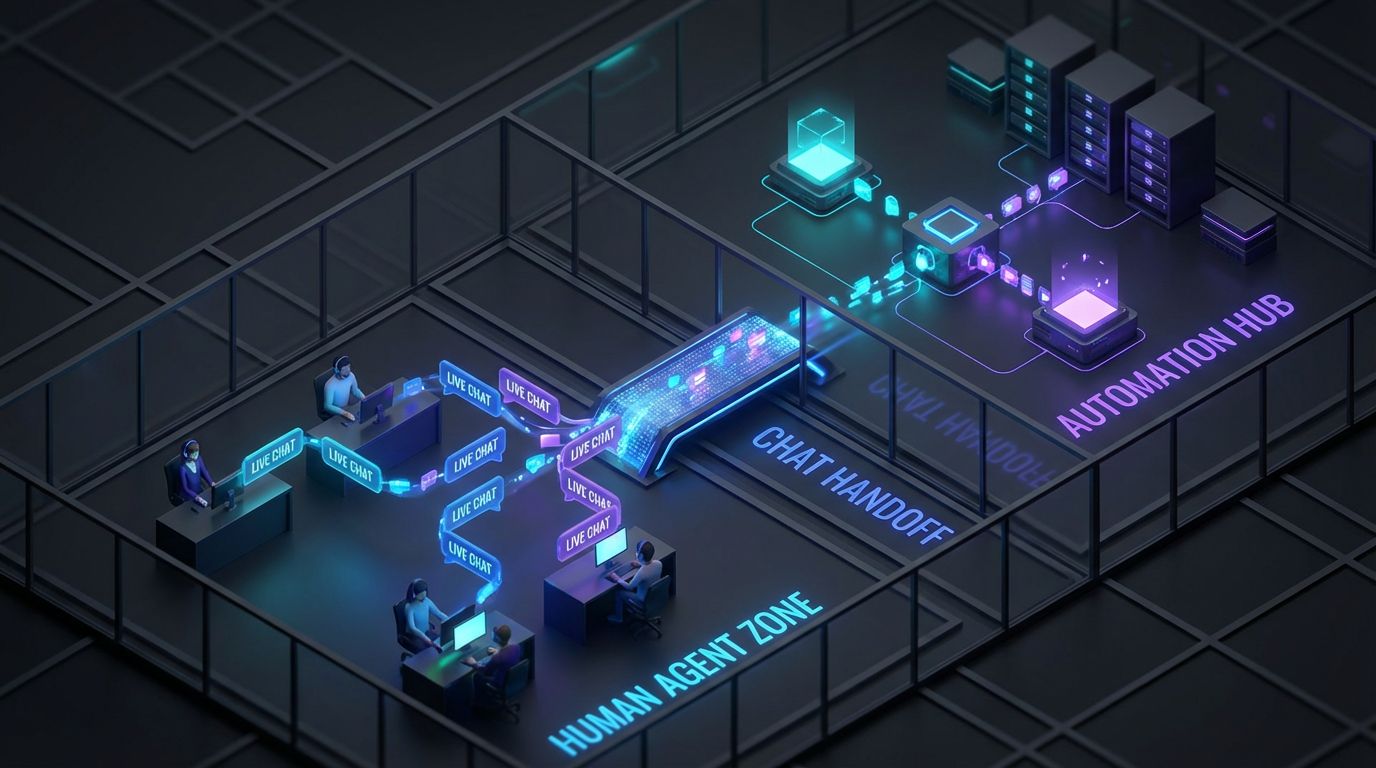
Most B2B sites still run chat like a digital helpdesk hotline: a small team covers business hours, answers whatever comes in, and hopes visitors are patient. Pre-chat forms collect a name and email at best, with little structure to route or prioritize conversations. The result is slow first responses, context lost between support and sales, and almost no systematic lead scoring.
The Old Manual Live Chat Model
In the manual model, every conversation competes equally for agent time, whether it is a basic “what are your hours” question or a high-intent pricing inquiry. Agents juggle multiple tabs and inboxes, copying snippets into the CRM when they remember. Leadership sees chat volume rising but cannot tie it cleanly to pipeline or deflection.
Even when teams perform well, coverage is limited by headcount and shifts, not by demand. After-hours visitors wait until the next morning, bounce to a competitor, or submit a form that no one follows up on quickly. Manual live chat becomes a cost center instead of a revenue channel.
Where Automated Live Chat Software Fits In
Automated live chat software promises to take the repetitive, predictable parts of these conversations off your agents’ plates. At the simplest end, you see rule-based bots that present fixed menus and canned answers to FAQs. In the middle, you see FAQ and search-style bots that use basic NLP to match common questions to knowledge base content.
At the advanced end, AI-powered systems combine natural language understanding with clear conversation flows, routing, and CRM integration. Done right, they become an intelligent front door: they greet visitors, detect intent, ask targeted questions, and either resolve the request or hand it to the right human with full context. The key is not the tool alone, but how it is architected into your stack.
Manual Live Chat vs Automated Chatbot for Websites
Here is how the old model compares with a well-implemented automation layer.
| Aspect | Manual Live Chat | Automated Chatbot for Websites |
|---|---|---|
| Availability | Business hours only; limited or no coverage on evenings/weekends. | 24/7 coverage; instant responses for common intents. |
| First-Response Time | Seconds to minutes depending on queue and staffing. | Sub-second responses for automated flows; humans join only when needed. |
| Cost per Conversation | Scales linearly with agent time and headcount. | Marginal cost near zero for routine intents once built. |
| Data Capture | Unstructured notes; inconsistent CRM updates; lost context between teams. | Structured fields (email, company, use case) pushed automatically into CRM. |
| Lead Qualification Quality | Depends on individual agent questions and notes; highly variable. | Standardized questions based on your ICP; consistent scoring and routing rules. |
| Agent Focus | Agents handle every inquiry, including basic FAQs and low-value chats. | Bots handle Tier 0/1; agents focus on complex, high-value conversations. |
| Reporting & KPIs | Basic volume metrics; weak connection to revenue or deflection. | Deflection %, lead capture rate, influenced pipeline, and SLA adherence. |
The point is not to replace humans, but to reserve them for the 20–40% of conversations where nuance, negotiation, or judgment actually matter. That is where well-implemented automation has the biggest impact on both experience and revenue.
How Automated Website Chatbots Really Work
Most marketing pages explain automated bots in abstract terms, but as an implementation architect, I look at very specific building blocks. If those blocks are not designed deliberately, you end up with a flashy widget that answers a few FAQs and quietly underperforms. Below is what has to be true for an automated chatbot to behave like an intelligent front-line rep.
Intents, Entities, and Conversation Paths (In Plain English)
Every conversation starts with an intent, which is simply what the visitor is trying to achieve: get pricing, book a demo, solve an issue, or research a feature. An effective automated chatbot for websites is trained to recognize a focused set of high-value intents and route visitors into specialized paths. Those paths map to structured question sequences that collect key entities like company size, industry, use case, or urgency.
For example, a visitor who types “Do you integrate with HubSpot?” should match an integration intent, receive a clear answer, and then be asked, “Are you evaluating us for an existing HubSpot setup or planning a migration?”. That follow-up question moves the chat from generic support to a potential sales conversation, which is where the revenue impact comes from.
Smart Routing and Human Handoffs
Once the bot understands intent, it has to decide where the conversation belongs. Self-service flows can fully resolve basic questions like passwords, plan limits, or documentation lookups. Sales intents like “pricing”, “talk to sales”, or “enterprise features” should follow a tighter script that validates fit and then routes into the right sales or account owner queue.
For complex or sensitive issues, the bot should escalate quickly, not stubbornly cling to automation. That means clearly defined handoff rules: for example, if a customer mentions “churn”, “cancel”, or a specific severity level, the conversation is pushed to a live agent with a summary of what has already been asked and answered. Smart handoffs protect customer experience while still letting automation handle the repetitive work.
CRM Capture, Lead Scoring, and Enrichment
A modern chatbot is not just a support interface; it is a structured data capture engine. As the bot asks questions, responses should map directly to CRM fields like lifecycle stage, product interest, and buying timeframe. That data powers immediate actions such as creating or updating a contact, logging the conversation, and opening an opportunity when criteria are met.
On top of that, you can apply lightweight lead scoring based on behavior (pages visited, time on site) and chat answers (budget, role, company size). With B2B Lead Scraping & Enrichment, you can add firmographics like industry and revenue, which sharpen routing rules. The end result is that your sales team receives fewer but much richer conversations, with clear priorities.
Basic DIY Bot vs Conversion-Optimized Chatbot Workflow
Not all “AI bots” are equal in terms of business impact. Here is the difference between a basic bot you can switch on in an afternoon and a conversion-optimized workflow that AiBizBuild typically designs.
| Aspect | Basic DIY FAQ Bot | Conversion-Optimized Chatbot Workflow |
|---|---|---|
| Purpose | Answer common questions and reduce some tickets. | Deflect Tier 1 tickets, qualify leads, and accelerate pipeline by design. |
| Intent Design | Loose topics; relies on keyword matches and generic search. | Curated high-value intents with tailored flows for support, sales, and success. |
| Data Capture | Optional email capture; minimal structure. | Structured forms in-conversation; maps directly into CRM fields and deal records. |
| Routing Logic | Simple “transfer to agent” when stuck. | Conditional routing by segment, score, and topic to the right queue or sequence. |
| Integrations | Basic email transcript or helpdesk ticket creation. | Deep CRM Integration & Inbox Management, plus triggers for outreach and booking. |
| Optimization | Ad hoc tweaks when someone notices issues. | Ongoing tuning based on deflection %, CSAT, and conversion analytics. |
The same underlying automated live chat software can deliver drastically different results depending on this architecture. That is why many “AI bot” deployments feel underwhelming: they were never designed against concrete KPIs.
Why DIY Live Chat Automation Fails

Most vendors market their platforms as “set up in minutes” and showcase eye-catching demos. What they do not show is the six to twelve months of sporadic internal effort many teams slog through before admitting the bot is not moving the needle. The gap between installing a widget and operating a reliable virtual rep is where DIY projects die.
The Tool Trap: “Set It Up in Minutes” Marketing
Self-serve platforms are built to minimize time to first response, not time to first meaningful result. You can drag a few nodes, connect an FAQ, and technically have an automated chatbot live by the end of the day. But without deliberate intent design, routing rules, and integrations, you have just created a more expensive contact form.
Behind the scenes, someone on your team still has to map conversation scenarios, standardize questions, connect every path into your CRM, and decide how to handle edge cases. That is not a one-time setup; it is a continuous process. When this work is nobody’s primary job, bots drift out of date and quietly degrade customer experience.
Common Failure Modes We See
The first pattern is poor intent coverage, where the bot only really understands a handful of FAQs and responds with generic “I’m not sure” messages to anything nuanced. The second is weak or missing escalation rules, which trap customers in loops or force them to repeat themselves when an agent finally joins. The third is data chaos: chats are not logged properly, leads are misrouted, and sales never sees the signals they care about.
In this configuration, automated live chat software actually adds friction instead of removing it. Your team spends more time babysitting the bot and cleaning up after it than they save from deflected conversations. That is usually when leadership concludes that “bots don’t work for us”—when in reality, the implementation never had a chance.
DIY Chatbot Tools vs Done-For-You Implementation (AiBizBuild)
Here is what changes when you move from a tool-only mindset to a system designed and maintained by a specialist partner like AiBizBuild.
| Aspect | DIY Automated Live Chat Software | AiBizBuild Done-For-You Implementation |
|---|---|---|
| Time to First Meaningful Result | Highly variable; often 3–12 months of sporadic iteration before seeing clear impact. | 3–6 weeks to a production-ready deployment focused on priority use cases. |
| Internal Hours Required | Marketing, RevOps, and Support leaders moonlight as conversation designers and integrators. | Your team provides input and approvals; AiBizBuild handles architecture, flows, and integration work. |
| Integration Depth | Basic plug-ins; partial CRM sync; manual follow-up workflows. | End-to-end CRM Integration & Inbox Management, plus links to outreach and calendars. |
| KPI Framework | Ad hoc metrics; difficult to attribute revenue or deflection. | Defined targets for deflection %, lead capture uplift, and pipeline influenced. |
| Ongoing Optimization | Reactive fixes when problems surface in support or sales feedback. | Proactive reviews of transcripts, intent performance, and scoring rules each month. |
| Business Ownership | Owned by “whoever set it up”; hard to govern and scale. | Owned jointly by your revenue leaders and AiBizBuild with clear playbooks and documentation. |
This is why the core decision is not “Which automated live chat software has the best features?”. The real decision is whether you want your highest-value people guessing at automation architecture, or a partner whose entire job is to compress that learning curve.
Why DIY Fails for Serious B2B Teams
For low-ACV, low-complexity products, a basic DIY bot can be enough. But once you are selling into mid-market or enterprise accounts, every high-intent conversation matters. The opportunity cost of mishandled chats—slow follow up, lost context, or poor qualification—quickly dwarfs the subscription cost of any bot platform.
Marketing and RevOps leaders already manage complex funnels, attribution models, and campaigns. Asking them to simultaneously be conversation designers, integration engineers, and QA analysts is a recipe for half-built flows and stale content. That is precisely the gap AiBizBuild is built to fill.
Mid-article CTA: If you recognize some of these failure modes on your own site, it is time to see what a purpose-built system could look like. Book a Website Chatbot Workflow Audit with AiBizBuild to get a concrete blueprint instead of another tool login.
A Conversion-First Use Case (B2B Lead Qualification)

To make this concrete, let’s walk through a realistic B2B scenario. You are driving paid and organic traffic to your site, but most visitors lurk, browse your pricing and solutions pages, and leave without filling out a form. Sales complains about lead quality and volume, and support is fielding repetitive questions from people who are not yet ready to buy.
The Scenario: High-Intent Website Traffic, Low Conversion
Imagine you sell a mid-market SaaS platform with an average contract value in the five-figure range. Your analytics show strong traffic to your pricing, integrations, and case studies pages, but traditional forms convert only a small fraction. Many buyers prefer chatting to filling forms, especially when they are still shaping their requirements.
Without a structured chat workflow, these buyers either bounce or ask vague questions that your agents do not consistently qualify. You are effectively leaking warm pipeline at the point of highest intent.
Step-by-Step Visitor Journey with an Automated Chatbot for Websites
Now layer in a conversion-focused automated chatbot for websites that is tightly integrated with your CRM. A prospect from a target industry lands on your pricing page and scrolls halfway; a behavior trigger opens a subtle prompt: “Comparing plans? I can help you match the right option in under 60 seconds.”. This is not a generic greeting; it is context-aware and time-boxed.
The visitor clicks, selects that they are evaluating for a team of 25, and types, “We need to integrate with HubSpot and Salesforce”. The bot recognizes a combined pricing and integration intent, responds with a concise answer about both integrations, then asks, “Are you planning to deploy this in the next 3 months, or just researching options?”. Based on their answer, the bot either continues to qualify or offers to book a demo.
Here is a simplified example sequence:
- Bot: “Got it, a team of 25 with HubSpot and Salesforce. Which best describes you: marketing leader, RevOps, or IT/admin?”
- Visitor: “RevOps.”
- Bot: “Perfect. Most RevOps leaders we work with care about implementation time and data sync. Do you have a timeline in the next 90 days?”
- Visitor: “Yes, by end of quarter.”
- Bot: “We can help with that. Want to see a tailored walkthrough? I can book 30 minutes with a specialist or share a case study for a similar team.”
At any point, the visitor can request a human, but the default path nudges them toward either a scheduled conversation or a content asset that matches their stage. The entire interaction is designed to be fast, relevant, and low-friction.
How Lead Scoring, Routing, and Follow-Up Work Behind the Scenes
While this plays out on the front end, the bot is collecting and structuring data. Role, team size, tools used, and timeline map directly to your CRM fields, along with UTM parameters and page context. A lead score is calculated based on behavior and answers; if it crosses a threshold, a new opportunity is created and assigned to the correct territory rep automatically.
The rep receives a summary of the chat with key qualifiers highlighted, not just a transcript. In parallel, the visitor is enrolled into a Cold Outreach Automation sequence tailored to RevOps evaluators, with messaging aligned to what they discussed. For deeper ideas on how to systematize follow-up after a qualified chat, see our ChatGPT for lead generation playbooks.
The Impact: From Chat Widget to Conversion Engine
In environments like this, it is common to see 2–3x more qualified leads captured from the same traffic because you are converting casual intent into structured opportunities. At the same time, agents handle fewer basic questions and can respond faster to the conversations that matter. Many teams also see 30–50% reduction in Tier 1 support volume when self-service paths are built alongside sales flows.
And because every interaction is logged correctly, your reporting finally connects chat touches to pipeline and revenue. Many teams pair chat automation with SEO Content & Blog Automation to drive more qualified visitors into these high-converting conversations.
CTA: Want to see what this could look like on your own pricing and solutions pages? Request a Done-For-You Chatbot Implementation Plan and we will map a lead qualification journey tailored to your ICP and tech stack.
Costs, ROI, and When to Bring in an Agency
When you evaluate automation, you cannot just compare subscription tiers across vendors. You need to look at total cost of ownership: internal time, integration complexity, and the opportunity cost of delayed improvements. Equally important is understanding when a lean DIY approach is sufficient and when the stakes justify bringing in a specialist agency.
Direct and Hidden Costs of Manual Live Chat
On paper, manual live chat seems straightforward: you pay for seats and staff them. In practice, the real cost includes training new agents, managing shift coverage, and the performance drag of context switching between channels. For growing teams, scaling coverage often means either night shifts or outsourcing, both of which come with quality and coordination challenges.
There is also the cost of missed opportunities: high-intent visitors who churn because no one was available, or deals that slow down because discovery was shallow in the initial interaction. An automated layer that handles predictable questions and pre-qualifies leads allows you to handle more volume without linear headcount growth.
Evaluating Automated Live Chat Software Pricing
Most automated live chat software is priced by seats, conversation volume, or feature tiers tied to AI capabilities and integrations. The sticker price is usually manageable compared to headcount. The problem is that software cost is often less than half of the true cost once you factor in deployment and upkeep.
You need to budget for configuration time, testing, integration work, and ongoing tuning as your products and policies evolve. Whether that work is done by your team or by a partner like AiBizBuild, it must be done for the bot to stay accurate and valuable.
When DIY Makes Sense (and When It Doesn’t)
DIY is reasonable when you have a simple product, a small team, and mostly FAQ-style questions. In that case, a basic bot that deflects common inquiries and captures occasional emails can deliver a solid return with minimal complexity. You should still treat it as an experiment with clear goals and a simple KPI like “reduce email tickets by 20%”.
Once you are coordinating multiple teams, handling complex routing, or working with high lead value, the calculus changes. At that point, the downside of under-qualifying leads or over-automating sensitive scenarios is too high to treat chat as a side project. That is when engaging an implementation partner becomes a straightforward ROI decision.
How AiBizBuild Implements Website Chatbots and Live Chat Automation
—IMAGE_BLOCK: Cinematic 3D Node Architecture: a volumetric visualization of a complex automation graph representing a website chatbot stack, with distinct glowing clusters labeled metaphorically as “Website”, “Chatbot”, “CRM”, “Inbox”, and “Outreach” nodes all interconnected in a clean lattice, symbolizing AiBizBuild’s orchestration of tools into a single system. Cinematic lighting, Unreal Engine 5 render, futuristic corporate aesthetic, glowing cyan and purple accents, shallow depth of field, 8k resolution—
AiBizBuild does not sell another chatbot widget. We act as the automation architect that sits between your website, your chosen automated live chat software, and your revenue stack. Our job is to align intents, flows, integrations, and KPIs so that live chat stops being a support cost center and starts being a predictable conversion and deflection engine.
Our Role: From Tool Selection to Workflow Architecture
We begin by understanding your current tools and constraints; in many cases, you already own viable chat or automation platforms. Instead of pushing you to switch, we focus on workflow architecture: how visitors move from anonymous traffic to qualified lead or resolved case. That includes how conversations enter and exit your CRM, support inboxes, and outreach systems.
Our core levers are CRM Integration & Inbox Management, Cold Outreach Automation, B2B Lead Scraping & Enrichment, and 24/7 Appointment Booking Systems. For teams ready to extend automation beyond the web, we can also plan for AI Voice Agents (Inbound/Outbound) as a future phase so that your phone and chat channels share one logic.
Our 5-Phase Implementation Framework
We use a predictable 5-phase framework so you know exactly what is happening and why at each step.
- Audit & Strategy – We map your current journeys, transcripts, and systems to identify automation opportunities across support, sales, and success. We define target KPIs such as first-response-time reduction, ticket deflection %, lead capture uplift, and pipeline influenced.
- Conversation & Intent Design – We identify and prioritize intents, draft conversation flows, escalation rules, and data capture requirements. This is where we align with your ICP, messaging, and governance so that content stays accurate and on-brand.
- Build & Integrate – We configure the chatbot within your chosen automated live chat software, connect it to your CRM and inboxes, and wire it into outreach tools and calendars. This is also where we apply B2B Lead Scraping & Enrichment where appropriate.
- Launch & Optimize – We roll out in controlled stages, monitor transcripts, and run A/B tests on prompts, questions, and routing. Early results inform tweaks to copy, scoring thresholds, and handoff triggers.
- Ongoing Tuning – We review performance regularly, refine intents, update content as your product and policies evolve, and adjust scoring as we learn from closed-won and closed-lost deals. Tightened content approval workflows help keep knowledge bases and bots in sync.
This phased approach closes the second big competitor gap: a lack of process and KPI framework. You are not just buying configuration time; you are buying a roadmap that keeps the system aligned with your business over time.
Example Deliverables You Get
By the end of an initial implementation, you will have clearly documented conversation flows for support, sales, and post-purchase scenarios. You will also have an integrated data model: which fields are captured in chat, how they map to CRM objects, and which triggers initiate outreach or assignment. Dashboards will show chat volume, deflection percentage, lead conversion, and SLA performance in one place.
For many teams, one of the most valuable outcomes is clarity: everyone understands which conversations the bot should own, which go straight to humans, and how success is measured. That alignment reduces internal friction just as much as it reduces response times for your customers.
Primary CTA: Ready to move from a half-baked widget to a fully integrated system? Book a Website Chatbot Workflow Audit with AiBizBuild and we will map your current stack, identify quick wins, and outline a phased automation plan.
FAQs on Website Chatbots & Live Chat Automation
How long does it take to go from manual live chat to a fully automated website chatbot?
With AiBizBuild, most teams see a first production-ready deployment in 3–6 weeks, depending on the number of intents, integrations, and how mature your existing content is. That includes design, build, and an initial optimization cycle focused on your highest-impact use cases. DIY timelines are often open-ended because the same people responsible for strategy and execution are also juggling other priorities.
Do we need a developer or in-house AI expert to work with AiBizBuild?
No; you do not need deep technical skills on your side. AiBizBuild handles the architecture, configuration, and integration work with your automated live chat software and CRM. Your team brings subject-matter expertise, brand voice, and final approval on flows and messaging.
Will an automated chatbot hurt our customer experience compared to human agents?
Done poorly, bots can frustrate users; done correctly, they usually improve experience. By focusing on clear intents, conservative guardrails, and fast human handoffs for complex issues, an automated chatbot provides instant answers for common questions while still respecting the need for human judgment. Customers get faster resolutions and fewer “sorry, we’re offline” dead ends.
How does an automated chatbot for websites connect to our CRM and sales process?
We structure chat data so every key answer maps to fields in your CRM via CRM Integration & Inbox Management. Qualified leads can automatically create contacts, deals, tasks, or sequences based on rules we define together. From there, we can also trigger Cold Outreach Automation so your follow-up is consistent and aligned with what was discussed in chat.
What kind of ROI should we expect from live chat automation?
While specifics depend on your baseline volume and traffic, it is realistic to target 30–60% deflection of Tier 1 inquiries after full rollout and optimization. On the revenue side, teams commonly see a 2–3x increase in captured leads from existing traffic due to better prompts, qualification, and routing. The combination of reduced support load and increased pipeline is where the strongest ROI emerges.
Can this approach support multiple languages or strict compliance environments?
Yes, but both add design and governance considerations. For multilingual experiences, we decide which intents and flows to localize and ensure your knowledge base content can support those languages. In compliance-heavy environments, we work with your legal and security teams to define what bots can and cannot say, how data is stored, and when to route straight to humans.
Conclusion
The shift from manual live chat to automation is not about replacing humans with robots; it is about redesigning your front line so humans focus on the conversations that truly need them. An automated chatbot for websites, when implemented as part of an integrated system, can turn your chat widget from a cost center into a conversion and deflection engine.
Picking an automated live chat software is only step one; the real leverage comes from intents, routing, integrations, scoring, and ongoing tuning. If you want to shortcut the trial-and-error and go straight to a measurable, ROI-positive deployment, Book a Website Chatbot Workflow Audit with AiBizBuild and let a dedicated automation architect design the system around your business, not the other way around.