

Job Application Automation: Ethical Shortcuts for Job-Seekers and Recruiters (Without Getting Burned)
Key Takeaways
– What job application automation really is: A spectrum from simple autofill and tracking to full-blown bots that search, fill, and submit applications at scale—and a clear line between assistive tools and risky, fully autonomous systems.
– Why most DIY tools disappoint: Generic AI content, weak targeting, and black-box scripts often lead to low interview rates, ATS suspicion, and long-term brand damage, as many “automate job applications reddit” users have learned the hard way.
– How to automate responsibly: Use a structured workflow that prioritizes strategy, filters, guardrails, and human review, and consider expert help when you need HR & Recruitment Screening Bots and tracking systems that are targeted, transparent, and compliant.
In This Guide:
🔍 What Job Application Automation Actually Means – The spectrum from autofill helpers to full bots
🧱 Manual vs Automated Job Search Workflows – Where automation helps and where it hurts
⚠️ Why DIY Job Application Automation So Often Fails – Lessons from tools and automate job applications reddit threads
🧠 Ethical and Legal Risks Recruiters Worry About – ATS rules, fairness, and employer policies
🛠️ A Step-by-Step Blueprint for Responsible Automation – How to design a targeted, human-led system
📌 Use Case: HR & Recruitment Screening Bots Done Right – How recruiting teams can automate ethically
📊 Manual vs Automated Applications: Time, Quality, and Risk – When automation is worth it
🤝 When to Bring in an Automation Partner – Turning scattered tools into a coherent workflow
❓ FAQs on Job Application Automation – Security, setup time, and ROI
What Job Application Automation Actually Means
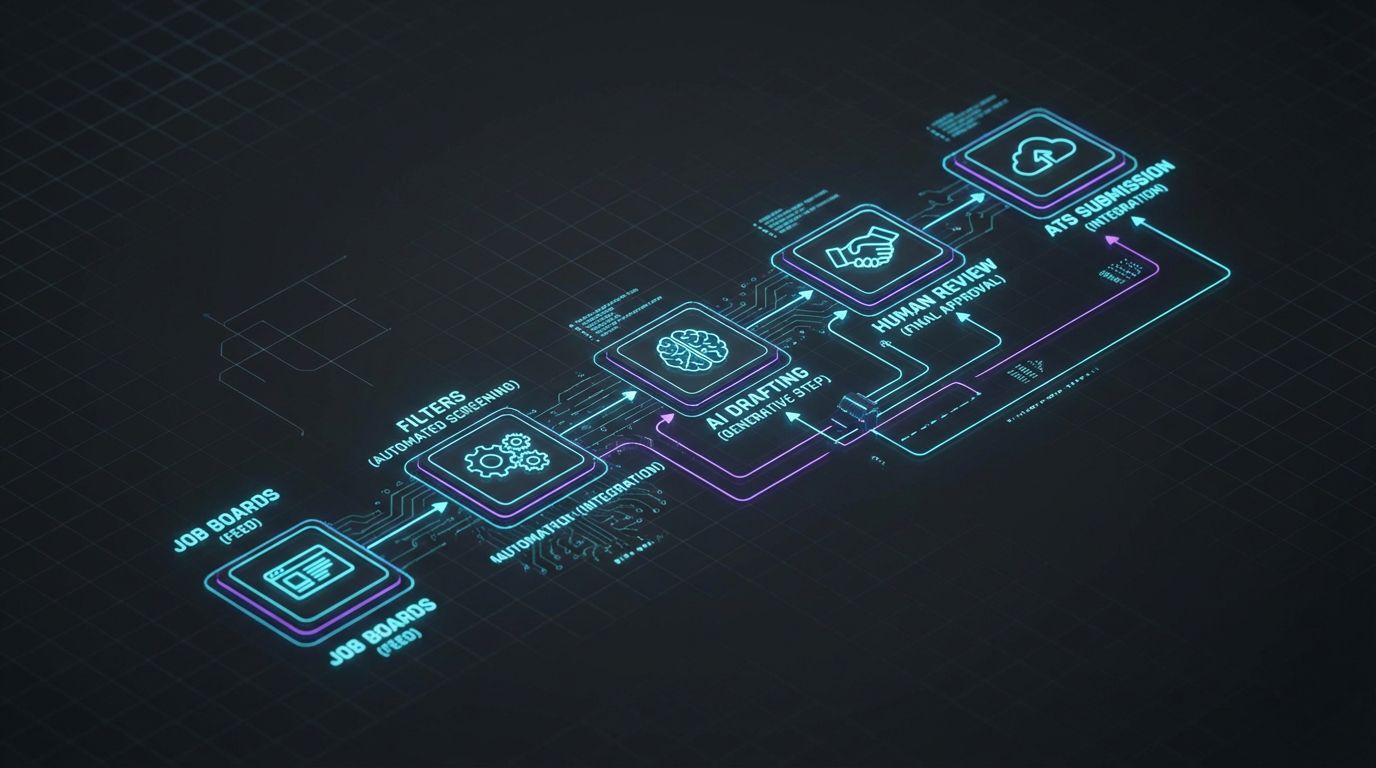
Job application automation has exploded in popularity as job seekers try to escape repetitive forms and as recruiters struggle to handle overflowing pipelines. At its core, job application automation means using software, scripts, and AI to streamline the steps between discovering a role and getting it into an applicant tracking system. The problem is that the phrase now covers everything from harmless autofill to opaque bots that can quietly fire off hundreds of low-quality applications a day.
From Autofill Helpers to Full Application Bots
On the light end of the spectrum, you have browser autofill, password managers, and resume uploads that populate standard fields. Slightly further along are ATS-integrated “quick apply” buttons and extensions that draft answers or cover letters from your resume and the job description. At the far end are full application bots that search for roles, parse descriptions, evaluate basic fit, generate materials, and submit applications with minimal or no human review.
Each step along this spectrum removes some manual effort but also removes some human judgment. Autofill saves you from retyping your address, while a “fire-and-forget” bot can change what jobs you are associated with in the market. Understanding where you are on this continuum is the first step toward using automation without burning your reputation.
How Common Tools Work Under the Hood
Most browser extensions work by reading the page’s HTML structure (the DOM), identifying form fields, and injecting your stored data into the right inputs. More advanced tools combine scraping with APIs from job boards or ATS vendors to pull listings into a centralized dashboard and sync status updates. AI layers typically take the job description and your resume as inputs, run them through a language model to draft tailored answers, and then paste those drafts back into the form.
Under the hood, matching is usually a mix of keyword overlap, basic semantic similarity, and sometimes user-defined filters like location or salary range. What these tools rarely provide is a clear, role-level strategy or guardrails that prevent you from applying to roles you should never have touched. The system design—what gets automated, what gets reviewed, and what gets tracked—is where outcomes are decided.
Why This Topic Is Exploding on Reddit and in Recruiter Circles
If you search for “automate job applications reddit,” you will find long threads from job seekers who bought multiple tools, sent hundreds of applications, and still saw almost no interviews. Many describe irrelevant roles, broken filters, and the uneasy sense that they may have spammed companies they actually care about. On the other side, recruiters talk about drowning in low-quality, AI-generated applications that all sound the same and barely match the role.
Both groups are reacting to the same problem: automation deployed without a transparent, end-to-end workflow. Job seekers want relief from busywork but end up with noise instead of traction. Recruiters want help prioritizing candidates but end up filtering sludge instead of signal.
Manual vs Automated Job Search Workflows

The Traditional Manual Job Search
In a traditional manual job search, you start by visiting multiple job boards, company career pages, and LinkedIn to search for roles. You copy-paste details into spreadsheets or notebooks, manually tailor your resume and cover letters, and then retype the same profile information into every portal. Tracking is often an afterthought, so you end up with half-updated spreadsheets, browser bookmarks, or just memory.
This process can easily consume several hours a day, especially if you are targeting multiple role types or geographies. The cognitive load is also high because you are constantly switching between searching, reading, writing, and form-filling. Over time, quality drops as fatigue sets in and your applications begin to blur together.
What Changes When You Add Basic Automation
Basic automation starts with simple tools that reduce repetition without making decisions for you. Autofill and quick-apply buttons cut down the time it takes to submit standard fields, while resume and cover letter templates give you consistent starting points. Application trackers and reminders help you stay on top of follow-ups and deadlines without relying on memory.
Used well, these tools can save you 10–15 hours per week and free up energy for networking and interview prep. Used poorly, they can encourage you to treat every role as a checkbox and skip the strategic thinking that actually drives offers. The key is to use automation to remove mechanical work, not the parts that require judgment.
Where Full Auto-Apply Bots Promise More Than They Deliver
Full auto-apply bots promise to search, match, and apply for you at scale, sometimes boasting 50–400+ applications per week. In practice, many real-world experiments show poor role matching, such as marketers being auto-applied to unrelated roles like dentists or teachers. Generic AI-generated answers and cover letters are reused across roles and companies, making it obvious to recruiters that minimal thought went into the application.
Another recurring complaint is the lack of transparency about where and when applications were sent. Users log in and see a counter of “applications submitted” but no clear record of job IDs, links, or outcomes. The result is a high volume of activity with very little learning, refinement, or improvement in interview rates.
Manual vs Automated Applications: Time, Quality, and Risk
To see the trade-offs more clearly, it helps to compare manual and AI-assisted applications side by side. The goal is not to replace manual work entirely but to shift effort away from repetitive tasks and toward higher-value decisions. A well-architected system should give you both speed and visibility, without turning you into a spammer.
| Aspect | Manual Applications | Automated / AI-Assisted Applications |
|---|---|---|
| Time per application | High (15–45 minutes each) | Low (1–5 minutes with good workflows) |
| Targeting quality | Usually high but limited by capacity | Can be high if filters and rules are well designed; often low with DIY mass tools |
| Content personalization | High but inconsistent as fatigue sets in | Consistent medium–high with AI templates plus human review |
| Risk of spam / brand damage | Low (volume constrained) | High with unmanaged bots; low with controlled, transparent workflows |
| Visibility into pipeline | Manual spreadsheets, often outdated | Dashboards and metrics when built on top of CRM/trackers |
Why DIY Job Application Automation So Often Fails
Most people approach job application automation the way they approach fitness trackers: buy a gadget, hope it fixes habits, and get disappointed six weeks later. The pattern shows up again and again in user experiments and internal recruiting metrics. The failure is almost never the language model itself; it is the lack of strategy and system design around it.
The Volume Trap – Confusing “More Applications” with “Better Outcomes”
When you are exhausted and anxious, quantity feels like progress, so sending 100–400 applications looks productive. In practice, a handful of targeted, high-quality applications plus networking and referrals almost always outperforms raw volume. Many users report 0–2 interviews after hundreds of auto-applications, while a single thoughtfully targeted role with a warm introduction turns into multiple rounds.
Automation makes it dangerously easy to confuse clicks with signal. If you do not track applications by source, role type, and level of personalization, you can spend weeks “being busy” without moving your interview rate at all. The goal is not to maximize application count; it is to maximize qualified conversations.
Black-Box Tools and Lack of Control
A common complaint about off-the-shelf auto-apply tools is that they behave like black boxes. Users often cannot see which exact roles were applied to, what answers were submitted, or how the tool interpreted their preferences. Filters like location, salary, or seniority sometimes behave unpredictably, leading to misaligned applications that are hard to unwind.
Without transparency, you lose the ability to learn from the data and refine your targeting. You also lose the ability to protect your own brand, because you may be associated with irrelevant or poorly written applications that you never saw. Any serious job application automation system must give you full visibility and editing control before submissions go out.
Recruiters Can Spot Generic AI Sludge
Recruiters see patterns across hundreds of applications per week, and generic AI output is very obvious at scale. Overused phrasing, buzzword-heavy bullet points, and awkwardly formal tone make it clear that little real customization occurred. When the resume, cover letter, and questionnaire answers tell slightly different versions of your story, ATS notes and recruiter comments start to reflect concern about authenticity or attention to detail.
Over time, this erodes your personal brand, especially in smaller industries where recruiters talk to each other. You want AI to help you say real things more clearly, not to generate a synthetic persona that falls apart under basic questioning. Consistency, honesty, and relevance matter more than perfectly polished but generic text.
For Recruiters, DIY Bots Can Amplify Bias and Noise
On the recruiter side, basic screening scripts or simple keyword filters promise fast triage but can easily entrench existing biases. Overweighting exact keywords can down-rank candidates with adjacent skills or non-traditional titles who could ramp quickly. Underweighting context means that a resume packed with buzzwords can outrank a more qualified but less “optimized” profile.
Without deliberate design, a DIY bot can silently filter out entire candidate segments or over-prioritize noisy resumes. That is a recipe for compliance risk and lost talent, especially in regulated industries. HR & Recruitment Screening Bots need explicit rubrics, explainable scoring, and human oversight to support fair evaluation instead of blindly replacing it.
Ethical and Legal Risks Recruiters Worry About
Ethical and legal risks are not abstract concerns for compliance teams; they show up as revoked offers, damaged employer brands, and regulatory scrutiny. Both job seekers and talent teams need a clear framework for what is acceptable and what crosses the line. Responsible job application automation starts with understanding where the boundaries are.
Terms of Service, Fair Use, and Platform Rules
Many job boards and employer portals explicitly forbid automated scraping, scripted logins, or bulk submissions that mimic human behavior. Ignoring those rules can lead to account bans, blocked IPs, or in extreme cases legal action against tool providers. For candidates, that can mean losing access to entire platforms or being flagged internally by employers.
A safer pattern is to automate around, not through, brittle portals. Use aggregators and alerts where allowed, keep your own structured logs, and avoid tools that require sharing your credentials for “full automation.” When in doubt, read the terms of service and look for explicit language around bots, scraping, and automated access.
Honesty, Misrepresentation, and AI-Generated Content
There is a clear ethical difference between AI polishing your own experience and AI inventing experience you do not have. Letting a model rephrase your bullet points, tighten your story, and align language with the job is reasonable. Letting it fabricate job titles, years of experience, or project outcomes you never delivered is misrepresentation.
If an employer discovers that your application contains invented experience, they are within their rights to rescind an offer or terminate employment. The reputational damage can also extend to referral sources and agencies that vouched for you. A good rule: everything in your resume and applications must survive a detailed behavioral interview and reference check.
Bias, Fairness, and Data Privacy in Screening Automation
For recruiters and HR leaders, the big risks are hidden bias and poor data governance. If your screening bot is trained only on past “successful” hires, it may bake in historical inequities and quietly downgrade candidates from underrepresented backgrounds. Without regular audits and fairness checks, you may not realize this until someone analyzes outcomes or a regulator asks hard questions.
Data privacy is another concern, especially when using external AI services to process resumes and applications. You need clarity on what data is stored, for how long, where it is hosted, and who has access. Responsible HR & Recruitment Screening Bots are designed with compliance in mind, including role-based access, minimization of stored personal data, and clear retention policies.
If you want a deeper look at how to use AI safely with clear processes and safeguards, see AiBizBuild’s guide on how to use ChatGPT safely with clear processes and safeguards. The same principles apply when candidate data replaces marketing content.
Practical Safety Tips for Job-Seekers and Talent Teams
For job seekers, keep a detailed log of every application: role, company, date, source, and key customizations. Review every AI-generated answer or cover letter before submitting, and avoid tools that refuse to show you exactly where they are applying on your behalf. Treat automation as a drafting and tracking assistant, not a decision-maker.
For recruiters, communicate your expectations clearly in job descriptions and candidate FAQs, including any stance on heavily automated applications. Be transparent when you use screening automation on your side, and provide simple explanations of how candidates are evaluated. Regularly audit outcomes for fairness and adjust your bots, rubrics, and workflows accordingly.
A Step-by-Step Blueprint for Responsible Automation
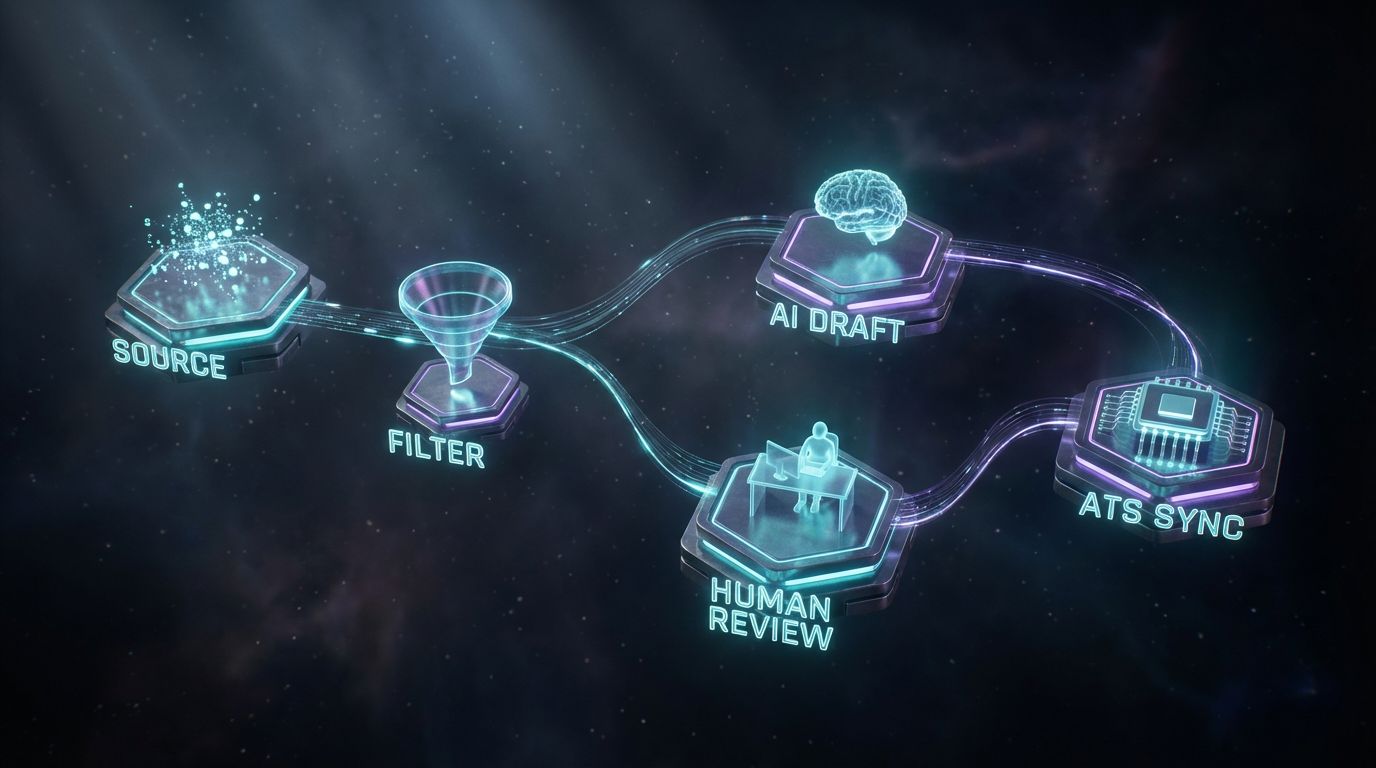
This is where we move from abstract pros and cons to a concrete blueprint. Whether you are an individual job seeker or a recruiting team, the structure is the same: map your current workflow, decide what to automate, add guardrails, and then iterate based on data. Tools plug into this system; they do not define it.
Step 1 – Define Your Target Roles and Ideal Companies
For job seekers, start by writing down the titles, locations, industries, and salary bands you are targeting. Be explicit about must-haves (for example, remote within a time zone, certain tech stack, minimum base salary) versus nice-to-haves. This becomes the filter logic for your automation, not a vague wish list.
For recruiters, build structured role scorecards that define required skills, preferred experience, and disqualifiers. Translate fuzzy phrases like “strong communicator” into observable evidence in resumes, questionnaires, or work samples. This structure is what you will later encode into HR & Recruitment Screening Bots.
Step 2 – Map Your Manual Workflow End-to-End
Before you add automation, list every step in your current process. For job seekers, that might be: find roles, skim job descriptions, shortlist, adapt resume, write cover letter, fill forms, log submissions, and follow up. For recruiters, it might include: ingest applications into ATS, initial resume screen, basic eligibility checks, send screening questions, schedule interviews, and update status.
This map becomes your blueprint for automation. You are not inventing a new process; you are upgrading an existing one, step by step. For a parallel example outside recruiting, see AiBizBuild’s breakdown of upgrading manual approval processes into automated workflows.
Step 3 – Decide What to Automate (and What to Keep Human)
Automation is best applied to tasks that are frequent, rule-based, and low risk. For job seekers, that includes aggregating jobs from multiple boards, pre-filling static profile fields, generating first-draft resumes and answers, and logging each application in a tracker. For recruiters, candidates can be auto-tagged by source, basic eligibility can be checked against must-have criteria, and standard communications can be templated.
Humans should retain control over prioritizing which roles to pursue, final review of all submissions, networking outreach, and interview decisions. The goal is AI-assisted applications, not AI-decided careers. Drawing this line up front prevents you from sliding into fully autonomous behavior without noticing.
Step 4 – Choose Your Tools and Integrations Thoughtfully
Once you know the steps and boundaries, you can choose tools by category instead of by hype. Common components include autofill extensions or password managers, AI writing assistants, application trackers or light ATS tools, and calendars or CRM-like systems for communication. For job seekers, this might be as simple as a browser extension plus a structured spreadsheet or lightweight CRM.
For recruiters, HR & Recruitment Screening Bots can plug into your existing ATS or CRM to score, tag, and route candidates based on your scorecards. CRM Integration & Inbox Management can centralize candidate emails, LinkedIn messages, and status updates so outreach and follow-ups are not lost across inboxes. Tools are modules in a larger architecture, not the architecture itself, which is how AiBizBuild approaches other domains like AI SEO writers inside a scalable content system.
Step 5 – Add Guardrails: Filters, Caps, and Reviews
Guardrails turn raw automation into a responsible workflow. Implement strict filters on keywords, titles, seniority, location, and compensation so you are only seeing roles that plausibly fit your target profile. Add daily or weekly caps on applications so you cannot accidentally blast out hundreds of low-quality submissions.
Make human review mandatory before anything is submitted. That might mean you or your team must approve each AI-generated resume, answer, or message, even if it only takes a minute. These small friction points protect your brand and keep the system aligned with your strategy.
Step 6 – Track the Funnel and Iterate
Job application automation only improves outcomes if you measure what happens after submission. At minimum, track applications sent, responses, interviews, offers, and rejections, broken down by source and type of application (fully manual, AI-assisted, or heavily automated). Calculate basic conversion rates such as applications-to-interviews and interviews-to-offers.
With that data, you can adjust filters, templates, and volume intelligently. You might discover that a small set of sources or role types produce the majority of your interviews, leading you to redirect effort there. For recruiters, funnel analytics can show which screening questions actually predict success and which just add friction.
Where an Automation Architect Adds Leverage
Designing all of this is not trivial, especially when multiple tools, boards, and stakeholders are involved. You need to manage data flows from job boards into trackers, from trackers into calendars and inboxes, and from ATS into reporting. You also need to encode nuanced rules and guardrails in ways that low-code tools can actually enforce.
This is where an automation architect or agency earns their keep. At AiBizBuild, the focus is on designing the workflow—the filters, handoffs, and approval steps—rather than selling yet another plugin. The outcome is a custom system that reflects your strategy instead of forcing you into someone else’s idea of a job search or hiring funnel.
Use Case: HR & Recruitment Screening Bots Done Right
So far, we have focused mostly on the candidate side, but recruiters are under equal or greater pressure. HR & Recruitment Screening Bots, when designed properly, can relieve that pressure without degrading fairness or candidate experience. The difference between “done right” and “done fast” is in the workflow.
The Recruiter’s Reality – Too Many Applicants, Too Little Time
In many organizations, a single in-house recruiter or small agency team handles dozens of open roles at once. Each posting can attract hundreds of applicants, many of whom are unqualified or clearly misaligned. Manually scanning each resume and updating status in the ATS quickly becomes unsustainable.
Service-level agreements around response time and candidate communication are hard to meet under this volume. Top candidates may drop out or accept other offers while waiting for a basic eligibility check. Meanwhile, hiring managers push for faster shortlists, creating a constant squeeze between speed and quality.
Designing a Screening Bot That Supports, Not Replaces, Recruiters
A well-implemented HR & Recruitment Screening Bot is essentially a structured assistant living inside your ATS or CRM. It uses your role scorecards to pre-screen applications based on must-have criteria like location, work authorization, years of experience, and key skills. It can trigger short forms or email questionnaires to clarify gaps instead of requiring a human to chase every detail.
The bot’s job is to surface a prioritized list of candidates with clear reasons for their scores, not to make final hiring decisions. Recruiters remain responsible for reviewing edge cases, assessing nuance, and making the call on who advances. This division of labor keeps humans in charge while removing the most repetitive screening work.
Example Workflow: From Application to Shortlist
Imagine a candidate applies via a job board that feeds directly into your ATS. The moment their application lands, the screening bot parses the resume and application form, maps fields to your scorecard, and assigns an initial score. If critical information is missing, it automatically sends a short, branded questionnaire and updates the record when the candidate responds.
Recruiters log into a single dashboard that shows candidates grouped by score bands with explanations, such as “meets required tech stack but lacks domain experience” or “strong match on core criteria, salary expectation pending.” From there, they can quickly move top candidates to the next stage, send rejections with respectful templates, or flag profiles for hiring manager review. The entire process from application to shortlist can compress from days to hours.
Benefits: Faster Time-to-Screen, Better Candidate Experience
With this kind of workflow, it is realistic to see a 50–70% reduction in time spent on initial screening. Recruiters can reallocate that time to deeper conversations with high-potential candidates and closer partnership with hiring managers. Candidates benefit from faster, clearer communication and fewer “applications into a black hole.”
Because the bot is applying a consistent rubric, you also get more reliable comparisons across candidates and roles. Over time, you can refine the rubric based on which screened candidates actually succeed in later stages or in the role. This is a concrete example of ethical job application automation that supports both sides of the market.
When to Bring in an Automation Partner
Not every situation requires an external partner, but there are clear signals that DIY is hitting its limits. If you recognize these patterns, it may be time to move from scattered tools to a coherent, well-governed system. That is where a workflow-focused partner like AiBizBuild comes in.
Signs Your DIY Automation Is Hurting More Than Helping
For job seekers, red flags include not knowing exactly where your applications are going, relying on tools that do not give you logs, and seeing no improvement in interview rates despite higher volume. If you cannot answer “how many applications led to first-round interviews last month, by source and role type,” your system is not giving you usable data. Another warning sign is feeling anxious about what your tools might be doing behind the scenes in your name.
For recruiters, you may find yourself still overwhelmed by noise even after layering in basic keyword filters or off-the-shelf automation modules. Candidate NPS or satisfaction scores may be dropping due to slow responses or inconsistent updates. If hiring managers complain about the quality of shortlists while your team feels maxed out, your current stack is not aligned with your process.
What an Agency Like AiBizBuild Actually Does (Beyond Tools)
AiBizBuild is not a low-cost SaaS product you sign up for and hope solves everything. It is a premium automation agency that focuses on designing and implementing custom workflows. In the context of job application automation, that means configuring HR & Recruitment Screening Bots and CRM Integration & Inbox Management around your specific roles, data, and constraints.
The work starts with a detailed workflow audit, then moves into system design, tool selection, integration, and testing. AiBizBuild connects your boards, ATS, and communication channels into one coherent pipeline, with clear guardrails and metrics. You get a maintained, evolving system rather than a pile of disconnected plugins.
What a Workflow Audit or Demo Looks Like
When you book a Workflow Audit with AiBizBuild, you can expect a structured review of your current job search or recruiting pipeline. That includes mapping your end-to-end process, identifying bottlenecks, and flagging any risky or non-compliant automation already in place. The outcome is a high-level blueprint of a safer, more efficient workflow that uses automation where it makes the most sense.
If you request a Demo, you will see how HR & Recruitment Screening Bots and CRM Integration & Inbox Management could work in your specific environment. The goal is not a generic product tour but a concrete view of what your future hiring or job search system could look like. When you are ready to move beyond piecemeal DIY tools, this is the fastest path to a robust, high-ROI automation architecture.
FAQs on Job Application Automation
Q1: Is job application automation against the rules of job boards or employers?
A: It depends on how it is implemented. Many platforms forbid scripted logins, scraping, or bots that mimic human behavior at scale, but do not object to tools that help you organize information or draft content. The safest approach is to respect each platform’s terms of service, avoid sharing credentials with third-party bots, and focus automation on drafting, filtering, and tracking rather than brute-force submission.
Q2: How long does it take to set up a responsible automation workflow?
A: For an individual job seeker, a well-designed AI-assisted workflow can often be set up in a few days if you have expert guidance on tools and process. For recruiter-side systems that include HR & Recruitment Screening Bots, ATS integrations, and dashboards, a realistic implementation window is 2–4 weeks from audit to initial rollout. More complex environments or strict compliance requirements can extend that timeline.
Q3: Do I need to know how to code to use or benefit from automation?
A: Most modern automation stacks use low-code or no-code tools, so you do not need to be a developer to operate them day to day. However, designing robust workflows, integrations, and guardrails still requires technical and process expertise. That is why many teams choose to work with specialists to architect the system, then handle routine use and iteration themselves.
Q4: How do we keep our automation from introducing bias or breaking compliance rules?
A: Start with clear, documented role scorecards and evaluation rubrics, then encode those into your bots instead of relying on vague “fit” metrics. Add regular audits of outcomes by demographic segment where legally permissible, maintain human oversight for final decisions, and keep detailed documentation of how your automation works. Partnering with experts who understand both workflow design and regulatory expectations can significantly reduce risk.
Q5: What kind of ROI can we expect from HR & Recruitment Screening Bots and workflow automation?
A: The most reliable ROI comes from time savings, reduced manual error, and faster time-to-hire, not from any promise of “guaranteed offers.” Recruiters often see initial screening time drop by 50–70%, while maintaining or improving shortlist quality and candidate satisfaction. For job seekers, a good system can free up hours each week for higher-leverage activities like networking and interview prep, which is where most offers are ultimately won.