

AI Product Description Generators: How to Stop Hand-Writing SKUs and Start Scaling Ecommerce Copy
If you’re still hand-writing or manually editing descriptions for thousands of SKUs, you already know it doesn’t scale. A typical ai product description generator can help you crank out first drafts faster, but the copy-paste, reformatting, SEO tweaks, and error fixes quickly erase most of that gain. The real leverage comes from an end-to-end system that connects your catalog, AI, SEO, and QA into a single repeatable workflow.
Key Takeaways
– Manual product copywriting doesn’t scale past a few hundred SKUs; a well-configured ai product description generator can cut description production time by 50–80% per SKU.
– The real gains come from templates, SEO frameworks, and human-in-the-loop QA — not from raw AI text alone.
– Most DIY AI setups stall at messy prompts and copy-paste work; a done-for-you workflow that connects your catalog, AI, and storefront is usually cheaper and faster than hiring writers to do it all manually.
In This Guide:
🔍 Manual vs AI Product Descriptions: What Changes and What Doesn’t
⚖️ Manual Copywriting vs AI Generators: Cost, Time, and Quality
⚠️ Why DIY AI Product Description Generators Often Fail
🧩 Templates, SEO Frameworks, and Human-in-the-Loop Quality Control
🛒 Use Case: Automating Product Descriptions for a 10,000-SKU Shopify Store
🛠️ The Hidden Cost of DIY Tools vs Done-For-You Workflows
🤖 How AiBizBuild Implements End-to-End AI Product Description Systems
❓ FAQs on Scaling AI Product Descriptions Safely
📅 Next Step: Book a Workflow Audit
Manual vs AI Product Descriptions: What Changes and What Doesn’t
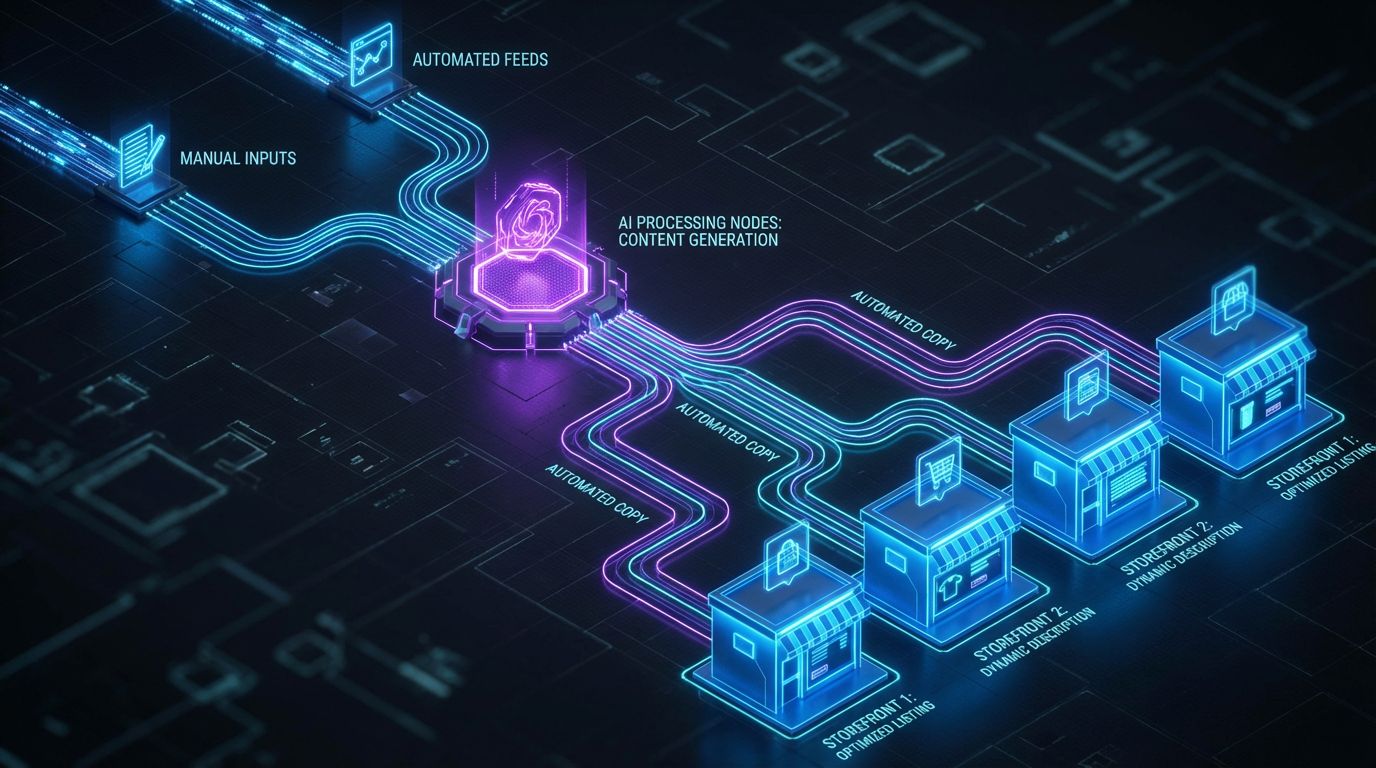
Manual product copywriting works until you cross a few hundred SKUs, then lead times and costs explode. AI changes the drafting layer but doesn’t replace strategy, positioning, or governance. The question isn’t whether AI can write a paragraph, it’s whether your system can reliably deploy thousands of those paragraphs into production without breaking your brand or your SEO.
The Reality of Manual Product Copy at 1,000–50,000 SKUs
At 1,000–50,000 SKUs, even a fast writer doing four high-quality descriptions per hour means 250+ hours per 1,000 SKUs. That’s weeks of work every time you launch a new collection, refresh packaging, or expand to a new marketplace. The symptoms are obvious: outdated specs, half-empty descriptions, inconsistent tone, and missed SEO opportunities on long-tail queries.
What an AI Product Description Generator Actually Does Well
Tools like Ahrefs, Copy.ai, Popupsmart, or a generic ChatGPT prompt are excellent at turning structured product data into a usable first draft. They can generate on-brand variations, handle translations, and adapt tone for different channels in seconds. Used correctly, an ai product description generator can cut drafting time by 50–80% while giving your editors a strong starting point instead of a blank page.
What Still Requires Human Judgment
What AI will not own is your positioning, differentiation, and risk tolerance. Humans still decide which benefits to emphasize, how aggressively to push claims, and which categories require full compliance or technical review. They also decide which products to prioritize in the first wave — hero SKUs, high-margin bundles, or high-traffic categories.
Insert Table: Manual Copywriting vs AI Product Description Generators.
| Criteria | Manual Copywriting | AI Generator (DIY) | AI System (AiBizBuild Workflow) |
|---|---|---|---|
| Time per SKU | 15–30 minutes per description | 3–8 minutes including prompting and copy-paste | 30–90 seconds including generation, routing, and QA |
| Cost per 1,000 SKUs | $5,000–$12,000+ in writer and manager time | $500–$3,000 in mixed tool + internal labor | $1,500–$4,000 including automation and review, amortized over multiple batches |
| Brand Consistency | Highly variable by writer; hard to govern at scale | Improved, but depends on ad-hoc prompts per user | Codified via shared templates, style guides, and prompt libraries |
| SEO Optimization | Manual keyword research and implementation, often skipped | Basic keyword insertion; duplicate content risks | Pattern-based SEO with unique angles, schema alignment, and internal linking hooks |
| Testing/A-B Capability | Rare, slow, and expensive to run meaningful tests | Manual experiments, hard to track systematically | Baked-in variants and A/B-friendly structures across PDPs and marketplaces |
Manual Copywriting vs AI Generators: Cost, Time, and Quality
Once you translate copy into per-SKU economics, it’s obvious why manual-only teams fall behind. The right AI approach doesn’t just write faster; it changes who does what and when. Your goal is to move human effort from typing words to designing playbooks and reviewing exceptions.
Time and Cost Per SKU: Manual vs AI-Assisted vs Automated Workflows
Manual-only: assume 20 minutes per SKU at a blended $40/hour rate; that’s ~333 hours and $13,000 per 1,000 SKUs. DIY AI with tools like Copy.ai or ChatGPT may cut drafting to 5 minutes, but copy-paste, formatting, and editing still land you at 80–120 hours per 1,000 SKUs. A fully automated workflow can push that down to 30–60 hours per 1,000 SKUs, with humans focused on QA and high-value SKUs instead of raw drafting.
Quality and Consistency Trade-Offs
Manual efforts can be great for a handful of hero products but tend to drift when 10+ writers touch the catalog. DIY AI improves baseline consistency but introduces new problems: prompt variance, hallucinated specs, and SEO patterns that aren’t enforced globally. A systematized AI workflow locks in templates, rules, and checks so your “good” becomes repeatable, not random.
Where Human Editors Add the Most Value
There’s almost no ROI in paying humans to write three generic bullet points about cotton t-shirts from scratch. There is real ROI in having a merchandiser or copy lead review only the top 10–20% of revenue-driving SKUs or high-risk categories. In well-designed workflows, editors focus on tuning hooks, validating claims, and testing variants — not retyping specs AI already pulled from your data.
Why DIY AI Product Description Generators Often Fail
Most teams have already “played” with an ai product description generator and ended up back in spreadsheets. The issue isn’t that the models can’t write; it’s that the surrounding process is still manual and brittle. This is the tool trap: adding another SaaS icon to your stack without changing how work flows end-to-end.
Prompt Chaos and One-Off Generation
In a DIY setup, each person invents their own prompts in Ahrefs, ChatGPT, or similar tools. Over time you end up with dozens of half-remembered prompts, inconsistent brand voice, and no way to roll out an improvement across thousands of SKUs. There’s no single source of truth for “how we write product descriptions here.”
Copy-Paste Work and Platform Silos
The usual pattern: export SKUs to CSV, prompt AI in one tab, paste results into another, then copy into Shopify, Amazon, or your PIM. That workflow is fragile and slow, and every handoff is another opportunity for mistakes. You save time on drafting but silently burn it on repetitive admin work.
No QA, No Governance, and Risk of Bad Data
Raw AI outputs will confidently invent dimensions, materials, or use-cases if your prompt or data is incomplete. In regulated categories (supplements, electronics, children’s products), that can turn into real liability. Without a defined QA layer, you’ll either overspend on manual review or ship risky copy to live pages.
How These Gaps Kill Trust, SEO, and Conversion Uplift
When product copy doesn’t match reality, customers start returning orders or simply stop believing your claims. From an SEO standpoint, thin or near-duplicate AI blurbs across similar SKUs can cannibalize rankings and trigger quality issues. The net effect is ugly: you pay for AI, still do manual rework, and never see the promised conversion lift.
Templates, SEO Frameworks, and Human-in-the-Loop Quality Control

The right way to use an ai product description generator is to treat it as an engine inside a larger machine. That machine includes templates, SEO rules, structured prompts, and explicit checkpoints where humans verify what matters. This is where most off-the-shelf tools stop and where serious ecommerce operations begin.
Conversion-Focused Product Description Templates
Strong templates usually follow a simple spine: scannable hook, benefit-led paragraph, bullets that translate features into outcomes, plus specs and FAQs. Fashion leans on fit, feel, and styling ideas; electronics emphasize compatibility, performance, and warranty; supplements focus on ingredients, benefits, and disclaimers. Those patterns get encoded into AI prompts so every SKU in a category shares a proven conversion structure.
SEO Best Practices for AI-Generated Product Copy
SEO-friendly doesn’t mean stuffing the same phrase into every bullet; it means mapping primary and secondary keywords to specific sections and ensuring each high-intent cluster has unique angles. Your product descriptions should support category pages and topical content, not compete with them, which is where an AI SEO writer at scale strategy ties everything together. Structured data (product schema, aggregate ratings, availability) plus strong copy give Google enough context to reward your PDPs with rich results.
Designing a Human-in-the-Loop Review Layer
Not every SKU needs a full line-by-line review, but every category needs a clear QA policy. Low-risk items might get spot-checked at 5–10% sampling, while regulated or high-liability categories get 100% review by merchandising, legal, or technical specialists. Rules-based routing ensures that only flagged or high-value descriptions hit human inboxes, turning QA into a targeted control rather than a new bottleneck.
Building Reusable Prompt Libraries and Style Guides
Instead of letting everyone freestyle prompts, you codify a small library tied to product types, audiences, and channels. Those prompts mirror your brand voice, banned claims, formatting standards, and internal vocabulary. At AiBizBuild, we align these with your governance rules and the kind of using ChatGPT safely for SEO workflows safeguards you already expect for other content.
Use Case: Automating Product Descriptions for a 10,000-SKU Shopify Store

Let’s ground this in a concrete scenario: a mid-market DTC brand on Shopify with 10,000 SKUs across apparel and accessories. They’ve dabbled with AI tools but still maintain a patchwork of old descriptions, supplier text, and half-edited AI drafts. They want a predictable way to refresh everything without parking the merch team in Google Docs for three months.
Starting Point: Disorganized Catalog and Inconsistent Copy
Before automation, their catalog export shows missing meta descriptions, inconsistent bullet styles, and product types that aren’t standardized. Amazon listings were built at a different time by a different agency, so tone and claims don’t match Shopify. Email campaigns pull product snippets manually, so every launch requires last-minute copy cleanup.
Designing the Automation Blueprint
The first step is mapping their data: product types, tags, collections, reviews, and attributes become the inputs for template assignment. A typical blueprint flows like this: Shopify export → data cleanup → category-based template mapping → AI generation → human QA routing → bulk import back into Shopify, Amazon, and Google Shopping feeds. From there, the same AI-ready descriptions can power email snippets, retargeting ads, and on-site search results.
Before/After Example: One Product, Three Channels
Take a best-selling “water-resistant commuter backpack.” Before: supplier copy lists fabric and dimensions, with no benefits or social proof; Amazon bullets are generic and duplicated across three similar SKUs. After: the PDP uses a hook around daily commuting pain, bullets tie features to outcomes (dry laptop, organized pockets, quick-access cards), while Amazon receives a stricter, keyword-rich bullet format and email gets a 1–2 sentence benefit-first snippet.
Results: Time Saved and Conversion Uplift
In a typical implementation, generating and QA’ing 10,000 descriptions takes 4–6 weeks instead of a full quarter. Teams often see 50–70% time savings on description production and a 5–15% uplift in PDP conversion rate where copy was previously thin or inconsistent. The bigger win is that future product launches plug into the same system, so adding the next 1,000 SKUs no longer feels like a fire drill.
The Hidden Cost of DIY Tools vs Done-For-You Workflows
A $49/month subscription to an ai product description generator looks cheap on paper. What that price never includes is the internal time you’ll spend configuring prompts, wrangling exports, and cleaning up bad outputs. When you add that overhead to opportunity cost, a done-for-you workflow is often cheaper by the end of the year.
The Tool Subscription Mirage
DIY tools are priced to feel like rounding errors, which is why they spread so fast. But when each team member builds their own backdoor workflow, you quietly add dozens of hours per month in manual glue work. That’s budget most ecommerce teams never attribute back to “the AI tool” — it just disappears into general operations.
Operational Overhead, Rework, and Quality Risks
The more your team leans on generic tools without process, the more exception handling they end up doing. Every hallucinated spec, off-brand phrase, or misaligned claim requires someone to fix it, often under time pressure before a launch. Over a year, that rework can easily outweigh what it would have cost to design a robust system once.
Insert Table: DIY AI Tool Stack vs Done-For-You Workflow Implementation.
| Aspect | DIY Tool Approach | Done-For-You with AiBizBuild |
|---|---|---|
| Setup time | Weeks or months of trial-and-error by internal teams | 3–6 weeks for scoped design, build, and rollout |
| Required in-house skills | Prompt design, scripting, API knowledge, SEO, QA | Product owners and merchandisers provide input; AiBizBuild handles technical and workflow build |
| Error risk (hallucinated specs, compliance) | High; QA is ad-hoc and depends on individual vigilance | Controlled via validation rules, sampling, and routed approvals |
| Ongoing optimization | Inconsistent; improvements live in individual docs and chats | Centralized updates to templates, prompts, and logic based on performance data |
| True total cost over 12 months | Tool fees + hundreds of hidden internal hours in setup and rework | Predictable project fee + light ongoing optimization, often lower than DIY by Q4 |
Why a Done-For-You System Is Often Cheaper by Q4
Run simple math: if your team spends 40–60 hours/month babysitting DIY AI workflows, that’s 480–720 hours/year. At a modest $50/hour blended rate, you’re spending $24,000–$36,000 just to keep a fragile setup running. A done-for-you implementation may cost similar or less but leaves you with a robust asset instead of a pile of brittle scripts and scattered prompts.
How AiBizBuild Implements End-to-End AI Product Description Systems
This is where we move from theory to how AiBizBuild actually builds these systems. Our focus is on E-commerce Operations (Shopify/Amazon) and SEO Content & Blog Automation, with optional CRM Integration & Inbox Management when you want product messaging to flow into lifecycle campaigns. The goal is not another tool; it’s a durable workflow that keeps working long after the first batch of SKUs is done.
Phase 1 – Catalog Audit and Data Mapping
We start with your current state: exports from Shopify, Amazon, your PIM/ERP, and any existing copy libraries. We identify gaps (missing attributes, inconsistent product types, messy tags) and define a normalized structure the AI can rely on. This is also where we prioritize which SKUs and channels should move first based on revenue and risk.
Phase 2 – Template and Prompt Architecture
Next we design category-specific templates and prompts for each major product family and channel. These templates encode your brand voice, SEO targets, legal constraints, and formatting rules. We also design prompt variants for testing so your team can learn, for example, which hero benefit framing yields the best add-to-cart lift.
Phase 3 – Workflow Automation and Platform Integration
Once templates are locked, we connect your product feeds to the AI engine and back into Shopify/Amazon via APIs or bulk import routines. The system can reference review data, inventory, and pricing to adjust messaging (e.g., emphasizing scarcity or social proof). From there, outputs can also be syndicated into email tools via our CRM Integration & Inbox Management work when lifecycle alignment matters.
Phase 4 – Human QA, A/B Testing, and Continuous Improvement
We implement routing rules so that different product categories hit the right reviewers and approval queues. Dashboards track defect rates, time-to-approve, and performance metrics so you can refine prompts instead of guessing, supported by the kind of automated content approval workflows you may already be using elsewhere. Over time, we adjust templates and prompts based on live test results, not opinions.
Where SEO Content & Blog Automation Fits In
Product descriptions do not live in isolation; they should echo and support your category pages and supporting blog content. Our SEO Content & Blog Automation work ensures PDP copy, collection pages, and long-form articles share a coordinated keyword and messaging strategy. That way, AI-generated product descriptions strengthen your overall search footprint instead of competing with it.
Engagement Model and Timelines
Most implementations follow a simple pattern: discovery and design in 1–2 weeks, build and integration in 2–4 weeks, and phased rollout from there. Once live, throughput commonly hits 2,000–5,000 SKUs per week depending on your QA policy. Throughout, your internal team stays focused on decisions and approvals, not on building automation from scratch.
FAQs on Scaling AI Product Descriptions Safely
How long does it take to implement an AI product description workflow for my store?
Most projects move from discovery to first live SKUs in 3–6 weeks. Timelines depend on catalog cleanliness, how many platforms you’re syncing (Shopify, Amazon, others), and how complex your approval flows are.
Can we trust AI-generated product descriptions to be accurate and compliant?
You should never blindly trust raw AI outputs for specs or regulated claims. Our workflows validate AI text against source product data and route higher-risk categories through human and, where needed, legal review so accuracy and compliance stay under control.
Will this replace our copywriters or merchandising team?
No — it replaces their repetitive drafting, not their judgment. Your experts move up the stack to own messaging strategy, testing, and oversight while AI handles the first 80% of the writing work.
Do we need in-house developers or AI specialists to maintain the system?
AiBizBuild handles the heavy lifting on design, integration, and maintenance. Your internal role is to provide product and brand input, give feedback on outputs, and adjust priorities — not to write code or manage AI infrastructure.
What kind of ROI can we expect from automating product descriptions?
Most teams see 50–80% time savings on description creation and a 5–15% lift in PDP conversion where copy quality was previously weak. Actual ROI depends on your traffic, current baseline, and how aggressively you test and iterate once the system is live.
Next Step: Book a Workflow Audit
—IMAGE_BLOCK: Futuristic Glass & Metal Product Shot showing a sleek metallic cube with glowing panels labeled Catalog, AI, SEO, and QA, symbolizing a unified workflow “product” you can deploy. Cinematic lighting, Unreal Engine 5 render, futuristic corporate aesthetic, glowing cyan and purple accents, shallow depth of field, 8k resolution—
Buying an ai product description generator is easy; turning it into a reliable, scalable system is where most teams get stuck. If you’re serious about scaling product copy without burning your merchandisers and writers, the next move isn’t another tool trial — it’s a blueprint. Book a 30-minute workflow audit and we’ll map how your current catalog, platforms, and processes could plug into an automated description pipeline, or request a demo of a full product description automation setup tailored to your stack.