

Ecommerce marketing automation: From manual campaigns to automated lifecycle marketing
Key Takeaways
– Ecommerce marketing automation is about building behavior-based lifecycle systems across email, SMS, and on-site—not just buying tools or sending more blasts.
– Manual newsletters and one-off campaigns cap revenue and team capacity, while automated lifecycle flows (welcome, cart recovery, post-purchase, win-back) typically drive 20–40% of store revenue when implemented well.
– Pairing a robust ecommerce marketing automation platform (Omnisend, Klaviyo, Drip, etc.) with AiBizBuild’s E-commerce Operations (Shopify/Amazon) service unlocks fast, compounding gains without DIY guesswork.
In This Guide:
📈 What Is Ecommerce Marketing Automation? – Clear definition and why it matters now
📨 Manual Campaigns vs Automated Lifecycle Flows – Where manual ecommerce email marketing breaks
⚙️ Core Lifecycle Flows Every Store Needs – Welcome, cart recovery, post-purchase, win-back
🛠️ Choosing the Right Ecommerce Marketing Automation Platform – Omnisend, Klaviyo, Drip & others
🚫 Why DIY Ecommerce Automation Fails – Hidden costs, tech debt, and stalled builds
📊 Implementation Blueprint & ROI Metrics – Step-by-step rollout and what to measure
🧩 Use Case: Shopify Brand Going From Blasts to Lifecycle Automation – Concrete example + numbers
🤝 Done-For-You Ecommerce Automation with AiBizBuild – How we build the system for you
❓ FAQs – Common questions from ecommerce leaders
If you are still cloning campaigns and sending the same newsletter to everyone, you are paying a hidden tax on revenue, time, and customer experience. Ecommerce marketing automation removes that ceiling by turning your traffic and customer data into always-on lifecycle journeys instead of sporadic blasts.
What Is Ecommerce Marketing Automation?
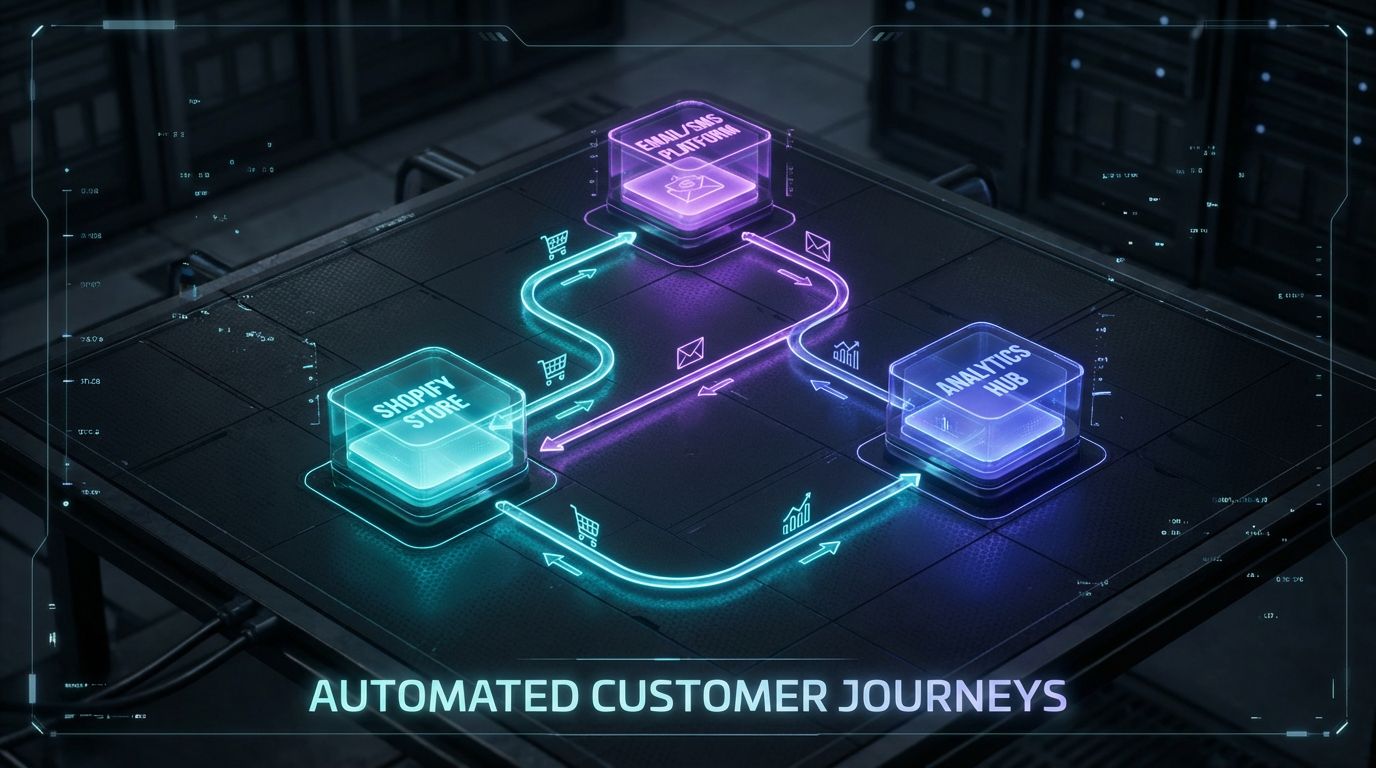
At its core, ecommerce marketing automation is the discipline of using customer data and predefined rules to send the right message, on the right channel, at the right time—without a human manually pushing send. Tools matter, but the real value comes from the lifecycle strategy and implementation behind them.
From “send to all” to behavior-based journeys
The old model is simple: build a list, send a newsletter, hope it converts. Behavior-based journeys flip this by reacting to actions like first visit, email signup, product view, cart add, purchase, and inactivity.
Instead of one-size-fits-all blasts, you orchestrate flows such as: new-subscriber welcome series, cart recovery sequences, post-purchase education, replenishment reminders, and win-back campaigns. Each journey is triggered by behavior, not calendar dates, so revenue becomes more predictable and less dependent on your team’s bandwidth.
Channels and touchpoints: email, SMS, on-site, and beyond
Modern ecommerce marketing automation systems coordinate multiple touchpoints, not just email. You combine email, SMS, push (when available), and on-site experiences like popups, banners, and personalized product blocks.
For example, a cart abandoner might see an exit-intent popup, receive an email 1 hour later, an SMS 24 hours later if still inactive, and a dynamic product recommendation block the next time they land on your homepage. The point is not spam; it is orchestrated, channel-aware sequences that respect consent and maximize conversion.
Tools vs systems: why an ecommerce marketing automation platform is only step one
Buying ecommerce marketing automation software like Omnisend, Klaviyo, or Drip gets you a powerful engine, but engines without a route map and driver go nowhere. Most brands use 5–20% of capabilities—a basic abandoned-cart email, a newsletter, and maybe a welcome discount.
A true ecommerce marketing automation platform becomes valuable only when you design a full lifecycle system: clear stages, event tracking, segment logic, and tested workflows tied to specific KPIs. That is where done-for-you implementation—like AiBizBuild’s E-commerce Operations (Shopify/Amazon)—turns unused features into measurable revenue and time savings.
Manual Campaigns vs Automated Lifecycle Flows

Most ecommerce teams feel the pain of manual ecommerce email marketing long before they can name it. You feel busy but not leveraged, and every sales push relies on someone building, segmenting, QA-ing, and scheduling campaigns by hand.
What manual ecommerce email marketing looks like in real life
- Weekly or bi-weekly newsletters built from scratch and sent to broad segments like “all subscribers” or “engaged last 90 days”.
- One generic abandoned-cart email (often triggered too late) with the same copy and discount for everyone.
- Ad-hoc holiday campaigns that require days of preparation and coordination between design, copy, and marketing leads.
- No systematic post-purchase, replenishment, or win-back flows—only occasional reactivation blasts when someone remembers.
On the surface this seems manageable, but as list size and SKU count grow, the operational drag and missed opportunities compound.
The cost of staying manual: time, missed revenue, and inconsistent CX
Manual campaigns have three main costs. First, the time cost: teams easily waste 10–20 hours/month cloning campaigns, adjusting segments, and fixing errors that automation could handle once and reuse infinitely.
Second, the revenue cost: with only a single abandoned-cart email and no structured welcome, post-purchase, or win-back journeys, brands commonly leave 15–30% of potential lifecycle revenue on the table. Third, the customer experience cost: inconsistent timing, generic messaging, and gaps between touchpoints erode trust and loyalty.
Insert Table: Manual Campaigns vs Automated Ecommerce Marketing Automation
| Aspect | Manual Campaigns | Automated Lifecycle Marketing |
|---|---|---|
| Setup Time | High effort every send; recurring 2–5 hours per campaign. | Heavier upfront design, then low incremental effort; flows run 24/7. |
| Personalization | Basic segments, generic offers, limited product relevance. | Behavior-based, uses browsing, purchase history, and dynamic product feeds. |
| Timing | Batch sends on fixed dates; misses real customer moments. | Triggered in real time by events like visit, cart add, and purchase. |
| Revenue Consistency | Spike-driven; if you skip a send, revenue dips. | More stable baseline from flows; campaigns become incremental upside. |
| Dependency on People | Heavily dependent on in-house marketer(s) and designers. | System-dependent; people focus on strategy and optimization, not repetitive builds. |
Lifecycle flows defined: welcome, cart recovery, post-purchase, replenishment, win-back
Automated lifecycle marketing focuses on a few high-leverage flow categories:
- Welcome/new-subscriber: converts first-time visitors into first-time buyers.
- Cart & browse recovery: brings back high-intent shoppers who stalled before checkout.
- Post-purchase & cross-sell: increases satisfaction, reviews, and average order value (AOV).
- Replenishment: reminds customers to rebuy consumables or refills based on product lifecycle.
- Win-back: reactivates lapsed customers before they fully churn.
Well-executed, these flows often drive 20–40% of total store revenue, while manual campaigns handle launches, promos, and brand storytelling on top.
Core Lifecycle Flows Every Ecommerce Brand Should Automate
The goal is not to automate everything at once. It is to build a focused set of ecommerce email marketing automation flows that consistently move customers from first touch to loyal buyers and brand advocates.
Welcome & new-subscriber series
Trigger: user subscribes to email (or SMS) via popup, footer form, quiz, or checkout opt-in, but has not purchased yet.
Typical 3–5 email sequence outline:
- Email 1 (instant): deliver incentive (if any), set expectations, highlight 1–2 hero products with social proof.
- Email 2 (24–48 hours): brand story + problem/solution framing, introduce category structure so shoppers know where to start.
- Email 3 (3–4 days): education or comparison guide, FAQs, gentle urgency if discount is expiring.
- Email 4–5 (optional): UGC/reviews, bestsellers, or quiz to segment preferences.
Key metrics: signup → first purchase rate, revenue per new subscriber over 7–14 days, and unsubscribe rate. A solid welcome flow often becomes your highest-ROI email marketing automation for ecommerce because it hits while intent is fresh.
Abandoned cart & browse recovery flows
Most stores run a single cart reminder with a generic subject line and maybe a discount. Sophisticated ecommerce email marketing automation goes further.
- Abandoned cart trigger: cart started but no order within X minutes.
- Browse abandonment trigger: multiple product or category views with no cart action.
Basic vs advanced approach:
- Basic: one email after 4–24 hours, same content for all, maybe a coupon.
- Advanced: 2–4 touch sequence across email and SMS, with branches based on AOV, product type (e.g., high-consideration vs impulse), and visit frequency.
For example, high-AOV carts might get more education and reviews before any discount, while low-AOV carts receive a faster, time-bound incentive. Metrics here include cart recovery rate, recovered revenue, and flow-attributed revenue per recipient.
Post-purchase, cross-sell, and review flows
After an order, most brands send a receipt and shipping notification and call it a day. A post-purchase automation turns a sale into the start of a lifecycle.
- Post-purchase education: how-to content, setup guides, FAQs, and usage tips that reduce returns and support tickets.
- Review/UCG request: timed to product delivery + satisfaction window, optionally with an incentive.
- Cross-sell recommendations: complementary products based on what was bought (e.g., accessories, refills, bundles).
Key metrics include review submission rate, support ticket volume, repeat purchase rate within 30–90 days, and post-purchase flow revenue.
Replenishment and win-back flows
For consumables and repeat-use products, replenishment flows are low-hanging fruit. You simply map approximate usage windows and schedule reminders.
- Replenishment example: for a 30-day supplement supply, schedule reminder emails at 21 and 28 days post-delivery, then a last-chance reminder at 35–40 days if no reorder.
- Win-back example: if a customer has not purchased for 90–180 days (depending on your category), trigger a 2–3 email sequence with new arrivals, incentives, and “we miss you” messaging.
Dynamic content can adjust products shown based on past orders and category interest. Typical benchmarks: win-back flows can re-activate 5–15% of lapsed customers, which compounds CLTV meaningfully over time.
Choosing the Right Ecommerce Marketing Automation Platform

This is where most teams start—with tools—rather than with the lifecycle map. The right ecommerce marketing automation platform does matter, but it should be chosen to support your strategy, not define it.
What to look for in ecommerce marketing automation software
When evaluating ecommerce marketing automation software, focus less on shiny AI buttons and more on whether it can support your real workflows.
- Native ecommerce integrations: deep, reliable connections with Shopify, BigCommerce, WooCommerce, or your platform of choice.
- Visual flow builder: drag-and-drop automation builder that supports branching logic, delays, and multi-channel steps.
- Segmentation: robust filters on events (opens, clicks, orders), customer attributes, and product behavior.
- Product feed & dynamic content: the ability to insert bestsellers, recently viewed items, and personalized recommendations.
- SMS support: especially valuable for cart recovery and time-sensitive flows.
- Reporting: clear attribution for flows vs campaigns, plus cohort and CLTV reporting where possible.
An ecommerce marketing automation platform that nails these basics will outperform a “feature-rich” tool without strong data and workflow foundations.
Quick overview of leading platforms
Here is a high-level view of some common email marketing automation for ecommerce tools.
- Omnisend marketing automation: purpose-built for ecommerce with strong Shopify integrations, email + SMS, and easy-to-launch templates.
- Klaviyo: powerful for data-driven brands, with granular segmentation, strong ecommerce data model, and robust flows.
- Drip: flexible automation and tagging, popular among DTC and content-driven brands.
- Others: platforms like ActiveCampaign and Mailchimp can work for simpler setups, but may require more customization for advanced ecommerce use cases.
AiBizBuild works across these tools, helping you either optimize your current stack or migrate to ecommerce marketing automation software that better fits your growth goals.
Insert Table: Ecommerce Marketing Automation Platform Comparison
| Platform | Best For | Strengths | Limitations |
|---|---|---|---|
| Omnisend | Shopify/BigCommerce stores wanting fast ecommerce-focused setup. | Strong native ecommerce blocks, email + SMS, user-friendly automation templates. | Less flexible than some enterprise tools for complex, custom data models. |
| Klaviyo | Data-driven DTC brands with multiple segments and higher SKU counts. | Granular segmentation, deep Shopify integration, powerful reporting and flows. | Can be overwhelming without a clear lifecycle strategy; higher learning curve. |
| Drip | Content-heavy brands needing flexible tagging and automation. | Good balance of automation power and usability; strong for funnels and tagging logic. | Less ecommerce-native than some rivals; may require more configuration. |
| ActiveCampaign | Brands wanting combined CRM + marketing automation. | Advanced automation builder, built-in CRM, strong for multi-step customer journeys. | Ecommerce integrations not as plug-and-play as Shopify-first tools. |
Why “best marketing automation for ecommerce” depends on your stack, SKUs, and strategy
There is no universally best marketing automation for ecommerce. The right choice depends on your ecommerce platform, SKU complexity, average order value, sales cycle length, and internal team capacity.
For a simple Shopify store with a narrow product line, a streamlined ecommerce marketing automation platform like Omnisend may be ideal. A complex catalog with multiple customer segments might benefit more from Klaviyo or a CRM-integrated stack where email marketing automation for ecommerce lives alongside sales and support data.
This is why AiBizBuild starts every engagement with an audit and stack review before recommending platforms—we architect around your lifecycle goals first, then select the ecommerce marketing automation software that supports them.
Why DIY Ecommerce Automation Fails
—IMAGE_BLOCK: Bioluminescent Data Streams swirling chaotically on one side and then aligning into clean, parallel channels on the other, representing messy DIY vs structured automation. Cinematic lighting, Unreal Engine 5 render, futuristic corporate aesthetic, glowing cyan and purple accents, shallow depth of field, 8k resolution—
Most teams do not fail because they are lazy. They fail because ecommerce automation is a systems problem being treated like a “send another email” problem.
The strategy gap: flows without a lifecycle map
Many brands start by opening their ecommerce marketing automation platform and building whatever flows the template library suggests. That leads to isolated automations with no clear map of how a subscriber moves from first visit to long-term loyalty.
Common symptoms include overlapping messages, gaps between stages, and inconsistent offers that confuse customers. Without a lifecycle map, you cannot prioritize or measure effectively, so the system stagnates.
The integration gap: Shopify, email, and ads not speaking the same language
Effective automation relies on clean, consistent events and properties: viewed product, added to cart, purchased, subscription status, AOV, categories, and more. If Shopify, your ecommerce marketing automation software, and your ads platforms are not aligned, segments break.
Misconfigured events lead to flows not firing, firing late, or firing repeatedly. This is exactly where AiBizBuild’s CRM Integration & Inbox Management and E-commerce Operations (Shopify/Amazon) expertise ensure data is modeled correctly and synced reliably.
The optimization gap: set-and-forget flows that decay over time
A “working” flow is not the same as an optimized one. Over time, product mix, pricing, seasonality, and list composition change, but most teams do not regularly revisit copy, timing, and segmentation.
Open and click rates decline, revenue per recipient drops, and what used to be a top-performing flow becomes average background noise. Without a testing and review cadence, you never capture the extra 5–10% uplift that compounds across flows.
The hidden costs of DIY vs bringing in an expert team
DIY feels cheaper because you are already paying your team, but the hidden costs are substantial. Time spent struggling through complex automation builders or debugging misfiring flows is time not spent on product, acquisition, or merchandising.
Misconfigured flows can easily leak 5–15% of potential email/SMS revenue through lost triggers, wrong segments, and poor deliverability. A focused expert team like AiBizBuild can stand up a robust system in 3–8 weeks, while internal DIY efforts often stretch into quarters of half-finished builds.
Implementation Blueprint and ROI Metrics
To move from theory to results, you need a clear 90-day roadmap and a small set of hard metrics. This is where a done-for-you partner can compress your timeline dramatically.
Step-by-step 90-day implementation roadmap
Weeks 1–2: Audit, data mapping, and platform selection/cleanup
- Audit your Shopify (or other) store, existing email/SMS setup, and historical performance.
- Document key events and properties (e.g., product categories, margins, replenishment cycles).
- Decide whether to double down on your current ecommerce marketing automation platform or migrate.
- Clean lists, fix core integration issues, and standardize naming conventions.
Weeks 3–6: Build and launch core flows
- Design and implement welcome/new-subscriber series, abandoned-cart and browse recovery, and core post-purchase flows.
- Set initial segmentation (e.g., engaged vs unengaged, VIP vs one-time buyers).
- Create baseline reports for flow revenue, automation revenue share, and key conversion rates.
Weeks 7–12: Add replenishment, win-back, and testing framework
- Implement replenishment logic based on product usage cycles and margin priorities.
- Launch multi-step win-back flows for lapsed customers with variant offers.
- Set up A/B testing for subject lines, incentives, and timing in high-volume flows.
- Align reporting on automation vs campaign revenue, CLTV trends, and segment performance.
This is the structured process AiBizBuild follows under our E-commerce Operations (Shopify/Amazon) service when clients book an Ecommerce Automation Workflow Audit.
Example lifecycle automation architecture
Here is a simplified text-based “map” to illustrate how flows and segments intersect:
Visitor → (email/SMS opt-in?) → Yes → Welcome Flow
                 ↓ No
        Retargeting Ads / On-site Prompts

First Purchase → Post-Purchase Education → Review Request → Cross-sell Suggestions
                 ↓ Time-based delay
        Replenishment Flow (if applicable)

No Purchase, but Cart Started → Cart Recovery Flow (email + SMS)

No Site Activity for 90–180 Days → Win-back Flow → Reactivated or Churned Segment

VIP Segment (high CLTV) → Exclusive Launches / Early Access Campaigns
The ecommerce marketing automation platform enforces these rules, but the architecture is what ensures every customer is always in the “next best” flow rather than stuck in generic campaigns.
How to measure ROI: from conversion uplift to CLTV
To keep this grounded and not hype-driven, focus on a small, consistent metric set:
- % of total revenue from automations vs campaigns: many healthy brands see 20–40% from flows and the rest from campaigns.
- Cart recovery rate and recovered revenue: the portion of abandoned carts converted by your flows.
- First purchase conversion rate from welcome flows: how well new subscribers become new customers.
- Repeat purchase rate and time-to-second-order: driven by post-purchase, replenishment, and win-back.
- CLTV vs CAC: automation should help you increase CLTV so you can afford more acquisition.
AiBizBuild builds dashboards inside your ecommerce marketing automation software so you can see these numbers by flow and segment within 30–90 days of implementation.
Use Case: Shopify Brand Going From Blasts to Lifecycle Automation
To make this tangible, let us walk through a representative (but anonymized) Shopify brand moving from manual blasts to a full ecommerce email marketing automation system.
Starting point: manual newsletters and a single abandoned-cart email
Profile: DTC health & wellness brand on Shopify, ~$80 AOV, ~70,000 monthly sessions, and a list of ~25,000 subscribers. The team sent one newsletter per week and had a basic abandoned-cart email firing 18 hours after cart creation.
Automation revenue accounted for only ~8% of total store revenue, mostly from that single cart email. The marketing manager felt maxed out, with no bandwidth to design or test additional flows and constant fear of “breaking something” in Shopify or their ESP.
What we implemented: full ecommerce email marketing automation
Within a 90-day engagement under AiBizBuild’s E-commerce Operations (Shopify/Amazon) service, we implemented:
- Welcome flow: 4-email sequence segmented by lead magnet source (discount vs content), focusing on education and bestsellers.
- 3-step cart recovery: reminders at 1 hour (no incentive), 24 hours (social proof + FAQs), and 72 hours (conditional incentive for non-discount-sensitive SKUs).
- Browse recovery: 2-step flow for high-intent category and product views.
- Post-purchase education + review: setup guides and FAQs, followed by a timed review request.
- Cross-sell flow: triggered 14–21 days after delivery, promoting complementary bundles.
We also aligned data between Shopify, their ecommerce marketing automation platform, and CRM records, leveraging light CRM Integration & Inbox Management where needed.
Results after 90 days (hypothetical but realistic)
While every brand is different and these are representative examples, not guarantees, the shifts looked like this:
- Automation revenue share: increased from ~8% to 25–32% of total store revenue.
- Recovered cart revenue: up by 15–25%, driven by better timing and multi-touch sequences.
- Repeat purchase rate (90-day window): improved by 10–18%, supported by post-purchase, cross-sell, and win-back flows.
- Internal time savings: marketing team reclaimed an estimated 12–18 hours/month previously spent on manual segmentation and repetitive campaign builds.
Campaigns did not disappear—they became higher quality, strategic layers on top of a solid automated lifecycle foundation.
Where AI and workflow automation fit in
AI is useful, but only after the lifecycle skeleton exists. In this use case we used AI to propose subject line variants, generate draft copy for education emails, and surface dynamic product recommendations for certain flows—always reviewed and edited by humans.
Beyond email, the same automation mindset can support upstream traffic and content operations. For example, AiBizBuild helps B2B and ecommerce brands build a scalable SEO content generation system and safe ChatGPT for SEO processes, prompts, and safeguards that feed qualified visitors into your now-optimized lifecycle flows.
Similarly, our experience building automated lead gen workflows and social media systems informs how we design multi-channel ecommerce journeys. But the heart of the offer here remains done-for-you lifecycle automation, not SaaS.
Done-For-You Ecommerce Automation with AiBizBuild
At this point, the real question is not “Which ecommerce marketing automation platform should I buy?” It is “Who can architect, build, and optimize the lifecycle system so my team is not stuck in the weeds?”
What we actually do (within approved service menu)
AiBizBuild is a premium automation agency, not a software vendor. Our core service for this problem space is E-commerce Operations (Shopify/Amazon).
Within that, we typically:
- Audit your store and marketing stack: Shopify/Amazon setup, current email/SMS platform, data quality, and performance benchmarks.
- Design lifecycle and data architecture: define key events, segments, and the end-to-end automation map from first visit to retention.
- Build flows inside your chosen ecommerce marketing automation platform: welcome, cart/browse, post-purchase, replenishment, win-back, and more.
- Integrate with CRM/ESP and basic inbox workflows: using our CRM Integration & Inbox Management capabilities where appropriate.
If you want to move quickly from manual campaigns to a robust lifecycle system, the next logical step is to book your Ecommerce Automation Workflow Audit so we can map out your specific opportunity.
How our implementation compares to going it alone
Compared to DIY, working with AiBizBuild typically means:
- Speed to value: end-to-end setup in 3–8 weeks instead of quarters of trial-and-error.
- Reduced internal hours: your team focuses on brand, creative, and campaigns instead of debugging flows and integrations.
- Lower risk: fewer broken segments, misfiring triggers, or deliverability hits from poorly configured automations.
Because we are tool-agnostic, we help you get the most out of whichever ecommerce marketing automation software you already have, or recommend a switch only when the ROI case is clear.
What a typical engagement looks like
Most ecommerce automation engagements follow three phases:
- Audit & blueprint: 360° review of your data, stack, and performance, leading to a documented lifecycle map and prioritized roadmap.
- Build & launch: we implement and QA flows, segments, and reporting directly in your ecommerce marketing automation platform.
- Optimize & handoff/ongoing: initial A/B tests, metric reviews, and either structured handoff to your team or ongoing optimization support.
If you want a concrete sense of timelines, opportunities, and expected ranges for your store, the best next step is to Book your Ecommerce Automation Workflow Audit with AiBizBuild.
FAQs
How long does it take to set up ecommerce marketing automation for a typical Shopify store?
Most Shopify implementations take 3–8 weeks, depending on catalog complexity, list size, and how clean your current setup is. We divide this into audit & blueprint (1–2 weeks), build & launch of core flows (2–4 weeks), and optimization & expansion (1–2 weeks).
Do I need a specific ecommerce marketing automation platform for AiBizBuild to work with us?
No. We work with leading ecommerce marketing automation software such as Omnisend, Klaviyo, Drip, and similar tools. As part of the engagement, we assess whether your current ecommerce marketing automation platform is the right fit and either optimize it or recommend a better-aligned option.
How do you measure ROI from ecommerce email marketing automation?
We focus on hard metrics: automation-driven revenue share, cart recovery rate, first-purchase conversion from welcome flows, repeat purchase rate, and CLTV trends. These are tracked inside your email marketing automation for ecommerce tool and, when relevant, connected to your CRM and analytics.
Is coding or in-house technical expertise required to maintain these automations?
For most clients, no. The heavy lifting happens in visual flow builders and prebuilt integrations, and AiBizBuild handles the complex configuration during implementation so your team can manage day-to-day edits without code.
How secure is my customer data when implementing these automations?
We work only with reputable ecommerce marketing automation platforms that follow industry-standard security practices. On our side, we use strict access controls and documented procedures when integrating Shopify, your ESP, and any CRM tools, with the goal of preserving data integrity and customer trust at every step.