

Automated Lead Qualification: From Manual Scoring to AI-Powered Routing
B2B teams do not lose pipeline because they lack data or tools; they lose it because their automated lead qualification is either missing or half-baked. Leads sit unscored in CRMs, get routed to the wrong reps, or receive follow-up days after they raised their hand. This guide shows you, in implementation-level detail, how to move from manual, opinion-driven scoring to an AI-powered, systematized lead engine that your sales org can trust.
Key Takeaways
– Manual lead scoring relies on inconsistent human judgment and slow triage, while automated lead qualification turns clear rules and data into a repeatable system that matters most for B2B teams with meaningful inbound volume.
– Modern ai lead management connects data sources, rule-based scoring, and machine learning models so you can continuously score, prioritize, and route leads to the right owners in real time.
– Getting this right requires a thought-through tech stack, well-documented workflows, and clear ownership, which together can cut response time to under 10 minutes while increasing the percentage of true sales-ready leads.
In This Guide:
📊 What Automated Lead Qualification Actually Is – Definitions, components, and how it differs from old-school manual scoring.
🧮 Manual vs Automated Lead Qualification – Compare processes, data, and outcomes side by side.
⚙️ How AI-Powered Lead Scoring & Routing Works – Data sources, rule-based models, and machine learning in practice.
🧱 Implementation Blueprint: Building an AI Lead Management System – Step-by-step checklist and tech stack.
⚠️ Why DIY Lead Qualification Systems Fail – Common pitfalls, edge cases, and hidden costs.
🚀 Use Case: 24-Hour Lead-to-Meeting System for B2B Sales Teams – A concrete workflow from lead capture to booked call.
🤝 How AiBizBuild Designs Your Done-For-You Lead Qualification Engine – Where our services plug in and what you get.
❓ FAQs on Automated Lead Qualification & AI Lead Management – Practical answers for B2B leaders.
What Automated Lead Qualification Actually Is
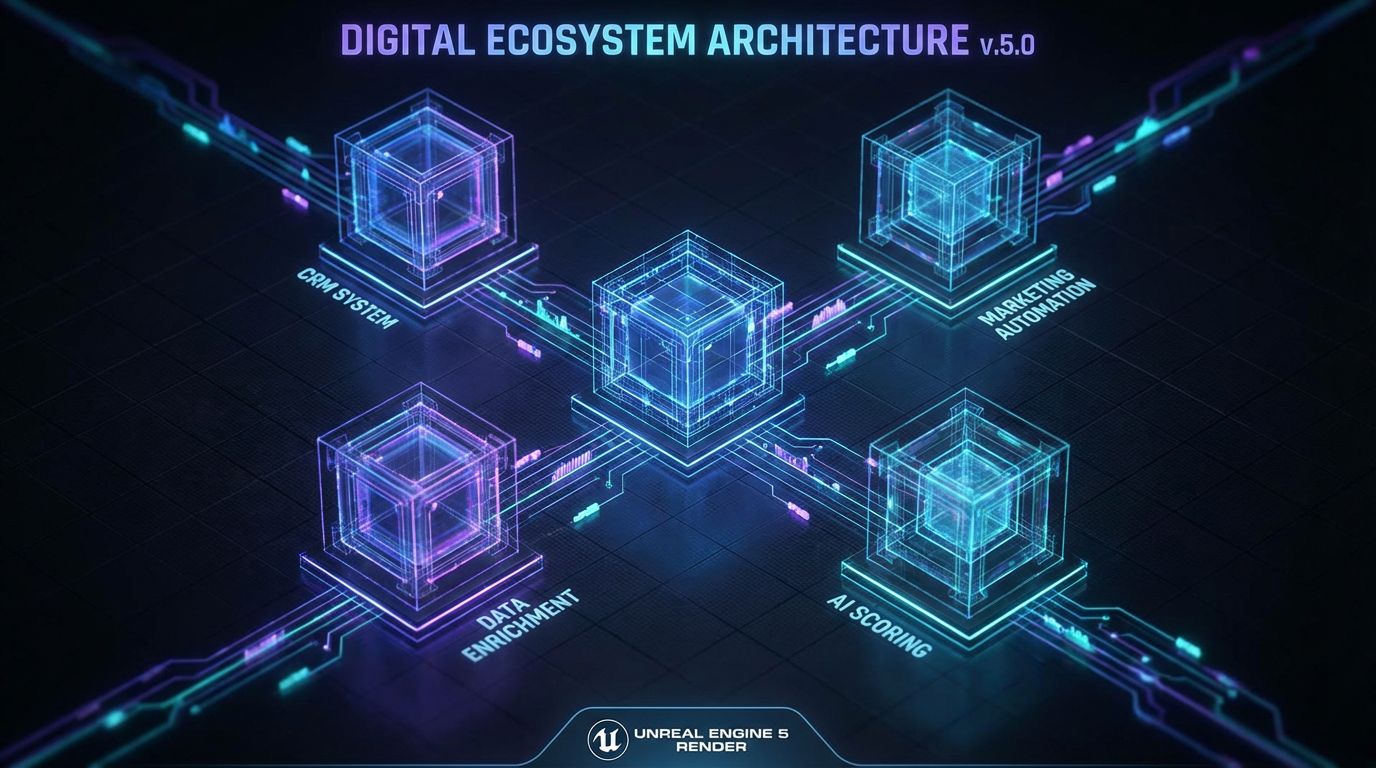
Most teams confuse “lead scoring” with a true automated lead qualification system. Basic lead scoring is usually a few fields and points inside the CRM, while real qualification is an end-to-end workflow that ingests data, calculates fit and intent, and then actually drives routing and activation. When done well, it becomes the backbone of your ai lead management engine rather than a forgotten settings page in your MAP.
In practice, automated lead qualification lives between capture (forms, trials, inbound calls) and human sales effort. It translates signals into standardized scores and statuses so that every record follows a predictable path: qualify, route, engage, or recycle. Your CRM, marketing automation platform, enrichment tools, and AI layers must all play defined roles in this system.
The CRM is the source of truth and routing hub, marketing automation handles messaging and nurture, enrichment plugs data gaps, and AI augments scoring and real-time decisioning. If any one layer is missing or misconfigured, your ai lead management workflows will leak valuable leads or flood reps with junk. The goal is one coherent pipeline from raw lead to sales-ready opportunity, not a patchwork of disconnected rules.
The Core Components of an Automated Lead Qualification System
First, define the data inputs you will rely on: firmographic (industry, employee count, revenue, HQ), demographic (job title, seniority), technographic (tools in use), behavioral (email engagement, pageviews), product usage (signups, logins, feature triggers), and intent data (third-party signals, pricing page visits). These must be mapped into consistent fields and values in your CRM. Without clean, unified fields, even the smartest scoring logic will behave unpredictably.
The scoring engine then converts these inputs into structured scores. At minimum, you want a Fit Score (how close they are to your ICP) and an Intent Score (how ready they are to talk to sales), each on a 0–100 scale. On top of that, you can later introduce ML-based models that learn from historical wins and losses to refine those scores.
Routing and activation is where value is actually created. This includes queues and assignment rules (who owns which segment or territory), automatic task creation, enrollment into outbound or nurture sequences, and triggers to your 24/7 Appointment Booking Systems or AI Voice Agents (Inbound/Outbound). If a “high-scoring” lead does not get different treatment than a low-scoring one, you do not yet have automated lead qualification—you just have a vanity score.
Manual vs Automated Lead Qualification
Manual qualification usually means SDRs or AEs eyeballing new leads each morning, cross-referencing LinkedIn, and making judgment calls based on experience. Spreadsheets or ad-hoc Salesforce reports guide who to call first, but there is no guaranteed SLA, and different reps use different criteria. The result is slow follow-up, inconsistent treatment of similar leads, and constant friction between marketing and sales over lead quality.
In an automated, AI-aware setup, leads are enriched, scored, and routed in seconds with minimal human intervention. The system checks ICP fit, evaluates intent signals, and assigns each lead to a tier with predefined follow-up rules. Reps log in to find prioritized queues already sorted, with tasks and sequences launched automatically according to the playbook.
Insert Table: Manual vs Automated Lead Qualification
Below is a practical comparison of how this looks in day-to-day operations.
| Aspect | Manual Lead Qualification | Automated / AI-Powered Lead Qualification |
|---|---|---|
| Data Inputs | Limited to basic firmographics and form fields, often incomplete. | Enriched firmographics, engagement behavior, product usage, and historical deal data. |
| Scoring Method | Static spreadsheets, subjective rep judgment, inconsistent criteria. | Rule-based + ML models that update scores in real time based on new signals. |
| Lead Response Time | Often 24–72 hours due to manual review and routing. | Typically minutes with automated routing, alerts, and follow-up sequences. |
| Sales-Ready Lead Rate | Low; reps waste time on poor-fit or low-intent leads. | Higher; leads are filtered by ICP fit + intent signals before hitting sales. |
| Operational Overhead | High; constant manual updates to scoring sheets and routing rules. | Lower; centralized workflows that can be tweaked and scaled systematically. |
The Business Impact: Response Time, Rep Efficiency, and Sales-Ready Lead Rate
When you move from manual to automated lead qualification, the most visible impact is on speed. It is common to see response times drop from 24–48 hours to under 10 minutes, especially when combined with automated email, SMS, and AI-driven callbacks. That speed alone materially improves connect rates and meeting acceptance.
Because the system filters out low-fit or low-intent leads, your reps spend more time on accounts that actually resemble closed-won customers. That can increase SQL rate substantially and save 10–15 SDR hours per week that used to be spent triaging or chasing unqualified demos. Over a quarter, this compounds into more predictable pipeline creation and cleaner forecasting.
Finally, these gains are not just about volume; they are about trust. When sales trusts that “MQL” or “PQL” actually means “worth my time,” your marketing <> sales alignment improves, and your ai lead management system evolves from a side project to a core revenue engine. You stop debating lead quality and start iterating on the model together using shared numbers.
How AI-Powered Lead Scoring & Routing Works

There are two main ways to assign scores: explicit rules you define and machine learning models that infer patterns from historical data. Most B2B teams should start with clear, rule-based models because they are transparent, auditable, and easy to adjust as stakeholders give feedback. Once your data is clean and you have enough volume, you can layer ML on top to fine-tune the system and catch non-obvious patterns.
Rule-based scoring is essentially a codified checklist: if job title contains “VP” or “Head of” in target functions, add points; if company size < 20 employees, subtract points. ML-driven scoring, by contrast, looks at hundreds of variables at once and asks, "What combination of signals historically led to wins or losses?" Well-governed ai lead management systems use both: rules for clarity and guardrails, ML for continuous optimization.
Data Sources You Should Be Feeding Into Your Scoring Model
Your CRM/contact layer should contain standardized fields such as company size band, industry taxonomy, revenue range, role/seniority, geography, and any disqualifiers (e.g., student, agency, competitor). Marketing engagement should capture opens, clicks, form submissions, webinar attendance, and key content interactions like viewing case studies or ROI calculators. Ensure UTM parameters and campaign IDs are consistently pushed into the CRM so you can trace which programs yield sales-ready leads.
Website and product usage data is increasingly critical, especially in hybrid PLG + sales-led motions. Key signals include signup source, login frequency, number of active users, use of “aha” features, and actions like inviting teammates or exporting data. High-usage free trials with buying-intent behaviors (like hitting plan limits or exploring billing pages) should earn significant Intent Score boosts.
Third-party enrichment and intent data rounds out the picture. B2B Lead Scraping & Enrichment can fill in missing firmographics, tech stack, and contact details so low-information leads become fully qualified profiles. You can also incorporate external signals such as technology installs, hiring trends, or content consumption patterns that indicate an account is in-market, feeding them into your broader ai lead management architecture.
Rule-Based Scoring: A Practical Starting Point
A simple, effective design is to maintain two separate scores: Fit Score (0–100) and Intent Score (0–100). Example Fit Score rules: +25 for target industry, +20 for employee range 200–2,000, +15 for titles like “VP Sales / RevOps / CRO,” +10 if in priority region, -30 if email domain is free (gmail, yahoo), -40 if industry is explicitly out-of-scope. Example Intent Score rules: +40 for demo request, +25 for pricing or ROI page views, +20 for attending a live webinar, -15 for repeated bounces or email unsubscribes.
From there, define tiers: Tier A if Fit ≥ 70 and Intent ≥ 70, Tier B if Fit ≥ 60 and Intent ≥ 50, Tier C if Fit ≥ 50 and Intent ≥ 30, everything else becomes nurture or recycle. Keep this matrix documented in a central playbook so marketing, sales, and RevOps share the same mental model. The point values themselves matter less than consistency and shared understanding.
Also build in negative signals that often get ignored. For example, subtract points if there are prior closed-lost reasons like “No budget” in the last 6 months, if they are in a churned customer account, or if they are from sectors where you consistently fail to win. Good automated lead qualification is not only about spotting high intent; it is about proactively filtering out bad-fit, high-noise leads that would otherwise clog your SDR queues.
Machine Learning Models: When and How to Layer Them In
ML starts to add value when you have at least a few hundred, ideally thousands, of closed-won and closed-lost records with reasonably consistent data. At that stage, models can learn subtle interactions such as “mid-market fintech in EMEA with two specific product behaviors tends to close faster than average,” even if no human wrote that rule. This is where ai lead management moves from static scoring to dynamic pattern recognition.
Practically, you still need clear labels: define what “good” means (e.g., Opp created, Closed Won ≥ $X ARR) and what “bad” means (no opportunity after 60 days, or disqualified for specific reasons). AiBizBuild helps extract, clean, and normalize this data so off-the-shelf ML tools or custom models are actually learning from reality, not garbage-in/garbage-out artifacts. The output is usually a propensity or “likelihood to convert” score that sits alongside your Fit and Intent scores.
Importantly, ML does not remove the need for rules or governance. You still want guardrails like “never send student or competitor domains to sales” and territory-based routing that respects account ownership. ML fine-tunes and augments your automated lead qualification; it should not turn it into an opaque black box that sales refuses to trust.
From Score to Action: Routing Logic and SLAs
Once scores exist, routing and SLAs determine what actually happens. Example: if Total Score ≥ 80 and ICP Tier = A, auto-assign to an AE, create a high-priority task due in 10 minutes, trigger a personalized email from the AE, and send a Slack alert to the appropriate channel. If Total Score 50–79 and Tier = B, assign to SDR queue, enroll in a multi-touch outbound sequence, and set an SLA of first touch within 4 business hours.
For Total Score < 50 or Tier = C, add to a nurture program only—no manual sales touch unless behavior changes and the Intent Score spikes later. Explicitly define SLAs for each tier: for example, Tier A inbound demos must get a first touch in under 10 minutes, Tier B in under 4 hours, Tier C via automated nurture within 24 hours. Keep these SLAs visible in dashboards and periodically audit compliance so your ai lead management workflows are grounded in operational reality.
Multi-contact, multi-signal situations need clear account-level logic. For example, if two contacts from the same domain have conflicting signals, you might prioritize the highest-seniority contact or treat the account as Tier A if any contact crosses a threshold. Document these edge cases in your playbook so routing is predictable and auditable, not a mystery.
Implementation Blueprint: Building an AI Lead Management System

This section is your practical, step-by-step path from manual, spreadsheet-driven processes to a cohesive ai lead management system. You can implement this in Salesforce, HubSpot, Pipedrive, or similar; the logic is tool-agnostic. The key is to treat lead qualification as a product with requirements, design, implementation, and maintenance—not a one-off ops task.
Step 1: Define ICPs, Stages, and Qualification Criteria
Start by defining 2–3 ICP tiers with simple, binary rules: industry list, company size ranges, revenue bands, and excluded categories. For each ICP tier, specify what constitutes an MQL (or PQL), SQL, and “sales-ready”—for example, MQL = ICP fit + key engagement, SQL = MQL with explicit interest in speaking to sales. You can reference frameworks like BANT or MEDDICC, but the important thing is converting them into concrete fields and picklists, not leaving them as tribal knowledge.
Example: “Budget” becomes a picklist field with values like “Confirmed budget,” “Can create budget,” or “Unknown,” rather than a note buried in call logs. “Authority” maps to job title + seniority fields instead of relying on free text. This allows your automated lead qualification logic to operate on structured data and keeps reporting clean.
Document these definitions in a simple internal spec that marketing, sales, and RevOps sign off on. This document becomes the reference point for your scoring rules, routing logic, and downstream reporting. It also provides the baseline for future adjustments as your GTM strategy evolves.
Step 2: Audit and Clean Your Data
Next, run a focused data audit to identify gaps that will cripple scoring. List the fields your model depends on (industry, employee range, country, role, lifecycle stage, last engagement date, product usage metrics) and calculate completeness and accuracy rates. You will likely find duplicate records, conflicting field values, and missing tracking for key forms or UTMs.
Fix what you can directly in the CRM: standardize picklists, merge duplicates, and set validation rules to prevent junk values going forward. Then use B2B Lead Scraping & Enrichment to backfill missing firmographics and technographics at both lead and account levels. This is where an implementation partner like AiBizBuild can systematically connect enrichment APIs, scraping workflows, and your CRM so data hygiene stops being a one-off clean-up and becomes an ongoing process.
Also check your analytics and marketing tools to ensure all key lead sources are properly tagging and pushing data into the CRM. It is common to find unlinked webinar platforms, offline event leads uploaded without source fields, or landing pages whose form submissions never reach the main database. Patch these leaks now so your automated lead qualification does not operate on partial information.
Step 3: Design Your Scoring Model and Routing Map
With clean data and clear ICPs, formalize your scoring model and routing map. Split scoring into Fit and Intent as described earlier, and define thresholds for each tier plus what action each tier triggers. For example, Tier A inbound demos go to named AEs, Tier A non-demo leads go to a high-touch SDR team, Tier B goes to a pooled SDR queue, Tier C goes into a nurture-only track.
Map destinations clearly: SDR, AE, partner channel, self-serve nurture, or spam/disqualify. Include territories (geo, segment, vertical) and account ownership rules to avoid conflicts like two reps working the same account. Capture everything in a central diagram or document that anyone in GTM can reference; treat it like a network diagram for your revenue ops environment.
This is also the right place to think through special cases: existing customers raising new inquiries, free trial users from current customer accounts, or leads from reseller/partner ecosystems. Decide whether those go to CSMs, AEs, partner managers, or an upgrade specialist queue, and encode that logic into your future workflows.
Step 4: Configure Automations in Your CRM & Marketing Stack
Now you translate the design into actual workflows. In tools like HubSpot, Salesforce, Pipedrive, or ActiveCampaign, create automation that runs on lead creation or significant updates: Form submission → Enrichment → Scoring → Tier assignment → Routing → Messaging. For example, a demo form submission triggers enrichment, updates firmographic fields, computes Fit and Intent Scores, sets Lead Tier, assigns an owner based on territory, sends a confirmation email, and creates a follow-up task.
For product-led motions, build workflows keyed off usage milestones rather than just form fills. Example: new signup with company size ≥ 50, invites ≥ 3 teammates, and feature X used twice within 7 days triggers a recalculation of Intent Score and, if over threshold, creates an SDR task plus enrolls the account in an outbound sequence. Over time, you can add additional triggers like “hit usage limit” or “visited pricing” to refine the system.
CRM Integration & Inbox Management is essential here to keep everything in sync. AiBizBuild typically centralizes email and calendar integrations, inbound routing rules, and logging so every AI agent touch, outbound sequence, and human reply syncs back into the CRM. That way, your automated lead qualification engine is running on full-fidelity interaction data, not partial snapshots.
Step 5: Layer in AI Agents and 24/7 Follow-Up
Once the core routing is in place, you can safely add AI as a force multiplier rather than a chaotic layer. AI Voice Agents (Inbound/Outbound) can answer inbound calls, qualify prospects against your ICP questions, and either book meetings directly or hand off warm conversations to humans. On outbound, they can handle initial callbacks on hot leads that just submitted demos or hit critical product milestones.
24/7 Appointment Booking Systems should be tightly integrated into your lead tiers and cadences. For Tier A leads, send immediate calendar links via email/SMS and expose inline scheduling on your thank-you pages; for Tier B, embed scheduling later in the sequence after one or two value-driven touches. The goal is to reduce lead response time to minutes and eliminate the “phone tag” and inbox ping-pong that kills momentum.
Importantly, every AI or automation touch should still honor your defined SLAs and routing rules. You do not want bots booking meetings on behalf of the wrong AE or offering times in the wrong time zone or territory. This is exactly where AiBizBuild’s system design focus differs from “just turn on this AI feature” messaging you hear from tool vendors.
Step 6: Monitor, Optimize, and Recalibrate
No automated lead qualification system is “set and forget.” You should track KPIs like average response time by tier, MQL → SQL → Opportunity conversion, disqualification rate, and rep time spent per SQL. Use dashboards to surface outliers, such as tiers with low conversion or reps consistently ignoring certain queues.
Set up a feedback loop where sales can flag mis-scored leads or patterns (e.g., “this industry is now a great fit,” or “these partners send poor-quality leads”). On a quarterly or bi-annual basis, review win/loss data and adjust Fit/Intent weights, thresholds, and routing rules accordingly. AiBizBuild often owns this recalibration cycle, ensuring the engine evolves alongside your GTM strategy.
The same workflow discipline you might apply to content approval workflows with routing and SLAs applies here—only now the stakes are revenue, not just content throughput. A governed, measured process will always outperform ad-hoc tweaks buried in a single admin’s head.
Insert Table: DIY Stack vs Done-For-You Implementation (Optional but Recommended)
Here is how a DIY build compares to a done-for-you implementation with a partner like AiBizBuild.
| Aspect | DIY Tech Stack | Done-For-You with AiBizBuild |
|---|---|---|
| Time to Implement | Often 2–6 months between competing priorities and trial-and-error. | 3–4 weeks for a production-ready v1 with clear documentation. |
| Internal Skills Required | Deep CRM admin skills, RevOps architecture, API integrations, and AI familiarity. | Your team focuses on ICP and sales process; AiBizBuild handles technical implementation. |
| Risk of Breakage | High; overlapping workflows, untested edge cases, and brittle custom code. | Lower; standardized patterns, regression-tested workflows, ongoing maintenance options. |
| Opportunity Cost | Sales and marketing leaders lose cycles managing implementation instead of strategy. | Leadership focuses on messaging and GTM; AiBizBuild ships the system. |
Why DIY Lead Qualification Systems Fail
Most DIY systems fail not because teams are incapable, but because lead qualification is treated as a one-off configuration project rather than an evolving product. The result is a brittle mess of rules scattered across CRM workflows, marketing automation, product analytics, and AI tools with no single owner. When something breaks or behavior changes, no one knows which lever to pull.
The Tool Soup Problem
Typical stacks include a CRM, MAP, enrichment tools, a product analytics platform, several AI widgets, and a couple of inbound/outbound tools. Each comes with its own “smart” features—scoring, routing, sequences—which leads to duplicated automations and conflicting logic. Leads get stuck in limbo between tools, or are spammed from multiple systems because routing was never centralized.
In this environment, you cannot tell which system is the source of truth for scores, status, or ownership. When reps see obviously bad leads marked as “high priority” or never receive tasks for important accounts, they stop trusting the data. The stack becomes a pile of disconnected tools rather than a coherent ai lead management engine.
Data Quality and Mapping Issues
Another failure mode is poor data hygiene and mapping. Different tools use different industry labels, role taxonomies, or lifecycle stages, and no one standardizes them at the CRM level. As a result, automated lead qualification rules fire incorrectly or not at all because the underlying fields are inconsistent.
You also see basic tracking gaps: missing UTMs, form fields that do not sync correctly, or disconnected channels like social and webinars. This leads to incorrect scores (e.g., treating a high-intent event lead as generic website traffic) and misrouted leads that end up with the wrong reps or in the wrong sequences. Over time, this erodes confidence in both the numbers and the automation.
Lack of Ongoing Ownership and Governance
Finally, most organizations have no explicit owner for the lead qualification engine. Marketing ops might own MAP workflows, sales ops owns CRM fields, product owns analytics, and no one owns the full system. As GTM strategy, territories, ICPs, and product lines change, the qualification logic falls further out of sync.
AI and automation actually increase the need for tight governance because a small misconfiguration can now scale errors across thousands of leads. Someone needs to own versioning, testing, documentation, and regular reviews. Without that, your automated lead qualification will drift until it becomes easier for reps to ignore it entirely.
How AiBizBuild Mitigates These Risks
AiBizBuild acts as your system architect and long-term maintenance partner for lead qualification. We centralize scoring and routing logic into a single, documented design that is then implemented across CRM, marketing automation, enrichment, and AI layers. This reduces duplication and ensures every tool plays a defined role.
We also bring opinionated patterns for data modeling, field naming, and tracking so future changes are easier and less risky. Our engagements typically include integration and testing phases where we run live and sandbox tests, simulate edge cases, and validate behavior with your reps before going fully live. Over time, we can manage ongoing tweaks as your GTM evolves, preventing the slow decay that kills most DIY systems.
Use Case: 24-Hour Lead-to-Meeting System for B2B Sales Teams
To make this concrete, let’s walk through a mid-market B2B SaaS company with both inbound demo requests and free trial signups. Initially, their reps are overwhelmed by volume, taking 24–48 hours to follow up, and jumping on too many unqualified demos. The objective is to build an automated lead qualification engine that turns any qualified hand-raiser into a booked meeting within 24 hours, ideally much faster.
Scenario: Inbound Demo Requests and Free Trial Signups
Leads are entering through three main doors: website demo requests, pricing page contact forms, and in-app trial signups. Today, all of them dump into the CRM with minimal enrichment and a generic “MQL” status, then get manually assigned to whichever SDR has bandwidth. Product usage is tracked in a separate tool that sales rarely checks.
Marketing is frustrated because they are hitting MQL targets, but sales complains about quality. Sales is frustrated because they are spending too much time sifting through noise and chasing leads that never should have been on their calendar. Leadership sees inconsistent pipeline and slow feedback loops on what is actually working.
End-to-End Workflow Walkthrough
Here is the upgraded, automated flow. Step 1: A prospect submits a demo form or starts a free trial; the submission instantly hits the CRM with source, campaign, and initial attributes. Step 2: B2B Lead Scraping & Enrichment runs automatically, filling in missing firmographics and technographics such as industry, employee count, and tech stack.
Step 3: The lead is scored in seconds using your Fit and Intent models, including trial behaviors like logins, feature use, and team invites. Step 4: If the lead crosses the Tier A or high Tier B threshold, CRM automation triggers Cold Outreach Automation sequences for the assigned SDR/AE, including personalized first-touch messaging. Step 5: In parallel, a 24/7 Appointment Booking System sends the prospect a tailored calendar link and displays scheduler options on the thank-you page or in-app.
Step 6: For the top tier, an AI Voice Agent or hyper-personalized email follow-up can reach out within minutes to confirm needs, answer simple questions, and nudge toward a booked time. Step 7: All activities—emails sent, calls made, meetings booked—are automatically logged and synced via CRM Integration & Inbox Management, so your dashboards show true lead-to-meeting performance. Lower-tier leads go into automated nurture, and their scores are recalculated as they engage more deeply.
Before-and-After Metrics (Hypothetical but Concrete)
Before implementation, average first-response time might sit around 36 hours, with many leads never receiving a true personalized follow-up. After the system is in place, Tier A leads receive automated confirmation and scheduling options within minutes, with human touches kicked off within the first hour. It is realistic to bring median response time for qualified leads to under 10 minutes when AI agents and scheduling are wired correctly.
Demo-to-SQL rate can move from, say, 25% to 45% because sales time is focused on ICP-fit, high-intent accounts instead of anyone who filled a form. SDRs can save 10–15 hours/week that used to be spent manually triaging spreadsheets, researching accounts, and wrangling calendars. These are illustrative numbers, but they are consistent with what well-implemented automated lead qualification systems achieve in B2B SaaS.
Upstream, you can also plug in SEO Content & Blog Automation to feed more qualified organic traffic into this engine. That way, the content you publish is not just generating views—it is systematically converted into scored, routed, and followed-up leads. The net effect is a tighter, more predictable lead-to-meeting and lead-to-opportunity funnel.
How AiBizBuild Designs Your Done-For-You Lead Qualification Engine
—IMAGE_BLOCK: Futuristic glass & metal product shot of a “Lead Qualification Engine” device composed of interlocking cubes labeled scoring, routing, AI agents, and enrichment, resting on a sleek dark desk. Cinematic lighting, Unreal Engine 5 render, futuristic corporate aesthetic, glowing cyan and purple accents, shallow depth of field, 8k resolution—
This is where we move from theory to how AiBizBuild actually plugs into your world. Our goal is to ship a working, well-documented automated lead qualification engine in weeks, not quarters. We do this by combining a repeatable implementation playbook with customization to your ICPs, GTM motion, and existing tech stack.
Our Engagement Model
A typical rollout takes 3–4 weeks for a v1 that your team can trust. Week 1 is discovery and data audit: we review your CRM schema, lead sources, current scoring (if any), and sales process, then map required fields and gaps. Week 2 is scoring and routing design: we define Fit/Intent models, tiers, SLAs, and routing rules, and get stakeholder sign-off.
Week 3 is automation build and integration: we implement workflows in your CRM/MAP, connect enrichment and AI services, and configure logging and reporting. Week 4 is testing, training, and go-live: we run simulations, fix edge cases, train your team on how the system works, and monitor behavior post-launch. From there, you can keep us on for iterative optimization or manage internally using the documentation we deliver.
Services We Bring to the Table (Within Approved Menu)
AiBizBuild’s lead qualification projects pull from a focused set of services. B2B Lead Scraping & Enrichment ensures every lead has the firmographic and technographic data needed for robust scoring. Cold Outreach Automation activates scored leads with tier-specific sequences across email, phone, and sometimes social, so no qualified lead sits idle.
AI Voice Agents (Inbound/Outbound) provide real-time qualification, follow-up, and meeting-setting, acting as always-on SDRs that follow your script and scoring logic. 24/7 Appointment Booking Systems convert interest into meetings automatically, integrated with your territories and rep calendars. CRM Integration & Inbox Management keeps everything synced so reps can work where they are comfortable while the system quietly orchestrates behind the scenes.
For top-of-funnel, we can connect SEO Content & Blog Automation and, when appropriate, Social Media Workflow Automation so that content and social campaigns feed directly into your scoring workflows. The result is an end-to-end ai lead management system where every channel, from search to social to product usage, flows into a consistent qualification and routing engine.
Call to Action: Book a Workflow Audit
If you suspect your current setup is leaking opportunities or wasting rep time, the lowest-friction next step is a Workflow Audit. In this session, we map your existing lead flows, scoring rules, and tool connections, then identify specific automation and AI plays that can increase your sales-ready lead rate. You get a concrete blueprint and recommended roadmap whether or not you choose to have AiBizBuild implement it for you.
For most teams, the upside is obvious: faster response times, more consistent routing, and reps focused on the right accounts. The downside risk is low because the audit is scoped, time-bound, and grounded in your current systems—not a theoretical AI workshop. From there, you can decide whether to DIY with clarity or partner with us to move faster and reduce execution risk.
FAQs on Automated Lead Qualification & AI Lead Management
How long does it take to implement an automated lead qualification system?
For most B2B teams with a mainstream CRM, a solid v1 can be designed, built, and launched in about 3–4 weeks. Timelines extend if data hygiene is very poor or you have many complex segments and territories, but the core engine does not need to be a multi-quarter project. We usually recommend shipping a lean but functional version first, then iterating based on live performance.
Do we need a data science team to use AI for lead qualification?
No. You can start with well-designed rule-based models using your existing CRM and marketing automation tools, then layer in off-the-shelf AI capabilities over time. Partnering with an implementation agency like AiBizBuild means you get practical ML and AI integration without hiring a dedicated in-house data science team. The critical part is having clean data and clear definitions of what “good” and “bad” leads look like.
Which tools and platforms do you typically integrate with?
We are tool-agnostic and focus on workflows first. Common environments include Salesforce, HubSpot, Pipedrive, and similar CRMs, paired with marketing automation platforms, enrichment providers, product analytics tools, and AI platforms for voice agents and decisioning. Our role is to orchestrate these into a single ai lead management system where routing and scoring are centralized and auditable.
How do you ensure the lead scoring model stays accurate over time?
We set up reporting to monitor conversion by tier and gather structured feedback from sales on mis-scored leads. On a quarterly or bi-annual cadence, we review historical performance, adjust weights and thresholds, and, where applicable, retrain ML models using updated win/loss data. This ongoing governance ensures your automated lead qualification evolves alongside your market and product, rather than drifting out of date.
Is automated lead qualification compatible with our existing sales process and territories?
Yes—routing logic is designed to reflect your current territories, account ownership rules, and sales stages, not replace them. We map your segments (SMB/mid-market/enterprise), vertical specializations, and account hierarchies into the qualification engine so reps keep working within familiar structures. The system simply ensures that the right leads get to the right owners faster, with clearer priorities and fewer manual steps.