

Automated Candidate Sourcing: How to Scale Talent Pipelines with AI (Without Drowning in Tools)
If your team is still living inside LinkedIn Recruiter, Indeed, and spreadsheets, you are already feeling the ceiling on manual sourcing. Automated candidate sourcing is not “one SaaS to rule them all” but a structured system: scraping, enrichment, outreach, screening, and ATS handoff working as one pipeline. This guide breaks down how to design that system so you can scale talent pipelines without drowning in tools, data chaos, or compliance risks.
Key Takeaways
- How automated candidate sourcing actually works across scraping, enrichment, outreach, and ATS handoff—and where manual sourcing hits a ceiling.
- What a modern, automated sourcing stack looks like vs. pure LinkedIn/Indeed grinding, including realistic cost per qualified candidate benchmarks.
- How a done-for-you AI sourcing implementation from AiBizBuild turns scattered tools into a compliant, measurable recruiting engine.
In This Guide:
- The New Landscape of Candidate Sourcing – Why manual sourcing alone can’t keep up
- Manual vs Automated Sourcing Stacks – Side-by-side comparison of workflows and costs
- Why DIY Automation Fails – Hidden complexity tools don’t solve
- Implementation Playbook – Step-by-step rollout with AI
- Compliance & Platform-Safe Automation – Avoiding bans and legal issues
- When to Bring in a Done-For-You Partner – How AiBizBuild plugs into your TA org
The New Landscape of Candidate Sourcing

Most Heads of Talent are being asked to do something impossible: increase candidate volume and quality while cutting spend and staying fully compliant. Meanwhile, your team spends nights inside LinkedIn Recruiter and Indeed trying to keep up with hiring managers. The result is a brittle, human-powered system with no real scalability.
Why Traditional Sourcing Hits a Ceiling
Traditional sourcing means recruiters manually searching LinkedIn, Indeed, and niche boards, copying profiles into spreadsheets or the ATS, and hand-sending messages. Follow-up is inconsistent because it depends on personal reminders and inbox discipline. You hit a hard ceiling when each recruiter can only manage so many searches, messages, and status updates before quality drops.
Under pressure to improve diversity, velocity, and quality simultaneously, this approach breaks down. Diverse talent pools require broader and more consistent outreach, not just a different Boolean string. Without system-level automation, every new role feels like reinventing the sourcing wheel and burning more recruiter hours.
What We Mean by “Automated Candidate Sourcing”
When we talk about automated candidate sourcing, we are not talking about a chatbot that magically hires people for you. We mean candidate sourcing automation as a set of coordinated workflows: data capture, enrichment, AI-powered scoring, triggered outreach, screening, and ATS syncing operating as one system. Think of it as automated talent sourcing pipelines instead of ad-hoc LinkedIn searches.
Concretely, that system includes: compliant scraping of candidate data, enrichment of profiles (skills, seniority, location), multi-channel outreach, HR & Recruitment Screening Bots for first-pass qualification, and CRM Integration & Inbox Management to push everything into your ATS. Recruiters stay focused on intake, stakeholder management, and closing — not manual copy/paste work.
Manual vs Automated Sourcing Stacks
Before you think about fancy AI sourcing workflows, you need to understand the difference between your current manual stack and a designed automated recruiting stack. The workflows are the same steps on paper, but the ownership and effort distribution are completely different.
The Manual Sourcing Stack (LinkedIn Tabs, Spreadsheets, and Late Nights)
The manual stack starts with recruiters spending hours in LinkedIn Recruiter, Indeed, and job boards building lists. They copy candidate data into spreadsheets or directly into the ATS, often with inconsistent fields and naming conventions. Outreach happens via hand-written emails and InMails, and follow-ups depend on calendar reminders or sticky notes.
Every new role means repeating the same steps: search, export, clean, message, chase, update ATS. There is no persistent, compounding data asset, and no feedback loop between hiring outcomes and how you search or message. LinkedIn recruiter automation might exist in the form of browser extensions or scripts, but it is usually fragile and risky.
The Automated Sourcing Stack (Scraping, Enrichment, Outreach, Handoff)
A modern stack treats each step as a reusable automation building block instead of one recruiter’s personal workflow. B2B Lead Scraping & Enrichment is configured to safely capture candidate data from approved sources and enrich it with titles, skills, seniority, and location. This creates structured, de-duplicated talent pools rather than one-off lists.
From there, Cold Outreach Automation runs multi-touch, personalized sequences via email and compliant LinkedIn-style outreach, while HR & Recruitment Screening Bots triage responses and ask a small set of structured questions. Finally, CRM Integration & Inbox Management syncs conversations and candidate states into your ATS/HRIS, keeping data clean and searchable.
Side-by-Side Workflow Comparison
Here is what the same sourcing process looks like as manual work vs a designed automated candidate sourcing workflow.
| Step | Manual Sourcing Workflow | Automated Candidate Sourcing Workflow |
|---|---|---|
| Sourcing / List Building | Recruiter searches LinkedIn/Indeed manually, opens dozens of tabs, copies names and roles into a spreadsheet. 2–4 hours per role. | B2B Lead Scraping & Enrichment runs predefined searches, de-duplicates, and stores candidates in a central list. Recruiter reviews and adjusts filters. 30–45 minutes per role. |
| Enrichment & Data Hygiene | Recruiter hunts for emails, checks locations, and updates titles by hand across multiple tabs. 1–2 hours per role. | B2B Lead Scraping & Enrichment appends contact info, location, seniority, and key skills using rules. Recruiter spot-checks segments. 15–30 minutes per role. |
| Outreach & Follow-Up | Manual emails and InMails, copy/paste templates, inconsistent follow-up, tracking via spreadsheet. 3–5 hours per role. | Cold Outreach Automation runs multi-touch sequences with merge fields, reply tracking, and automatic follow-ups. Recruiter monitors and tweaks copy. 45–60 minutes per role. |
| Screening & Qualification | Recruiter manually screens each reply, asks basic questions, and schedules calls. 2–3 hours per role. | HR & Recruitment Screening Bots ask structured questions, qualify against must-haves, and hand off only qualified candidates with context. Recruiter focuses on high-value calls. 45–90 minutes per role. |
| ATS Handoff & Reporting | Manual data entry into ATS, inconsistent statuses, limited reporting. 1–2 hours per role. | CRM Integration & Inbox Management pushes structured candidate records and statuses to ATS automatically with tags and source data. 15–30 minutes per role. |
Across one role, it is common to save 6–10 recruiter hours by shifting from manual sourcing to a systematic automated candidate sourcing stack. Scaled across multiple recurring roles per quarter, that is the difference between barely keeping up and being able to plan ahead.
Why DIY Automated Sourcing Usually Fails
Most teams have already experimented with some form of candidate sourcing automation: Chrome extensions for LinkedIn recruiter automation, a basic sequencing tool, or a generic AI sourcing product. The problem isn’t lack of tools; it’s lack of system design, governance, and integration.
Too Many Tools, No System
Without an architecture, you end up with a “tool zoo”: scraping tools, enrichment tools, email tools, and an ATS that all live in their own silos. Candidates get duplicated, contacted twice by different recruiters, or never moved beyond spreadsheet status. Reporting becomes impossible because each step lives in a different system with different IDs.
This is exactly how you end up with lost candidates, double outreach, and bad data that your leadership no longer trusts. Buying more SaaS without a cohesive workflow is how DIY automation becomes more work than manual sourcing.
Misconfigured Scraping, Enrichment, and Scoring
A lot of DIY setups lean on aggressive scraping that quietly violates LinkedIn/Indeed policies or ignores basic rate limits. Others over-collect data without enrichment rules, creating floods of junk candidates and duplicates that clog the ATS. When scoring is just keyword matching, you reward keyword stuffers rather than genuine fit or potential.
The impact is immediate: response rates drop because your outreach isn’t targeted, and diversity goals suffer because automation amplifies existing biases in your search logic. This isn’t an AI problem; it’s a systems and configuration problem.
Outreach and Screening Bots Without Governance
Another common failure mode is turning on generic outreach templates and bots once, then never revisiting them. Messages become stale, screening questions drift away from role requirements, and no one is measuring conversion from reply to interview to hire. Over time, this quietly damages your employer brand.
AiBizBuild’s role is to design, govern, and tune these workflows on an ongoing basis: structured testing of subject lines, message variants, and bot scripts tied to real hiring outcomes. A structured Workflow Audit usually surfaces these issues and quick wins in 1–2 weeks, long before you consider replacing your tech stack.
The Implementation Playbook: Building an Automated Sourcing System
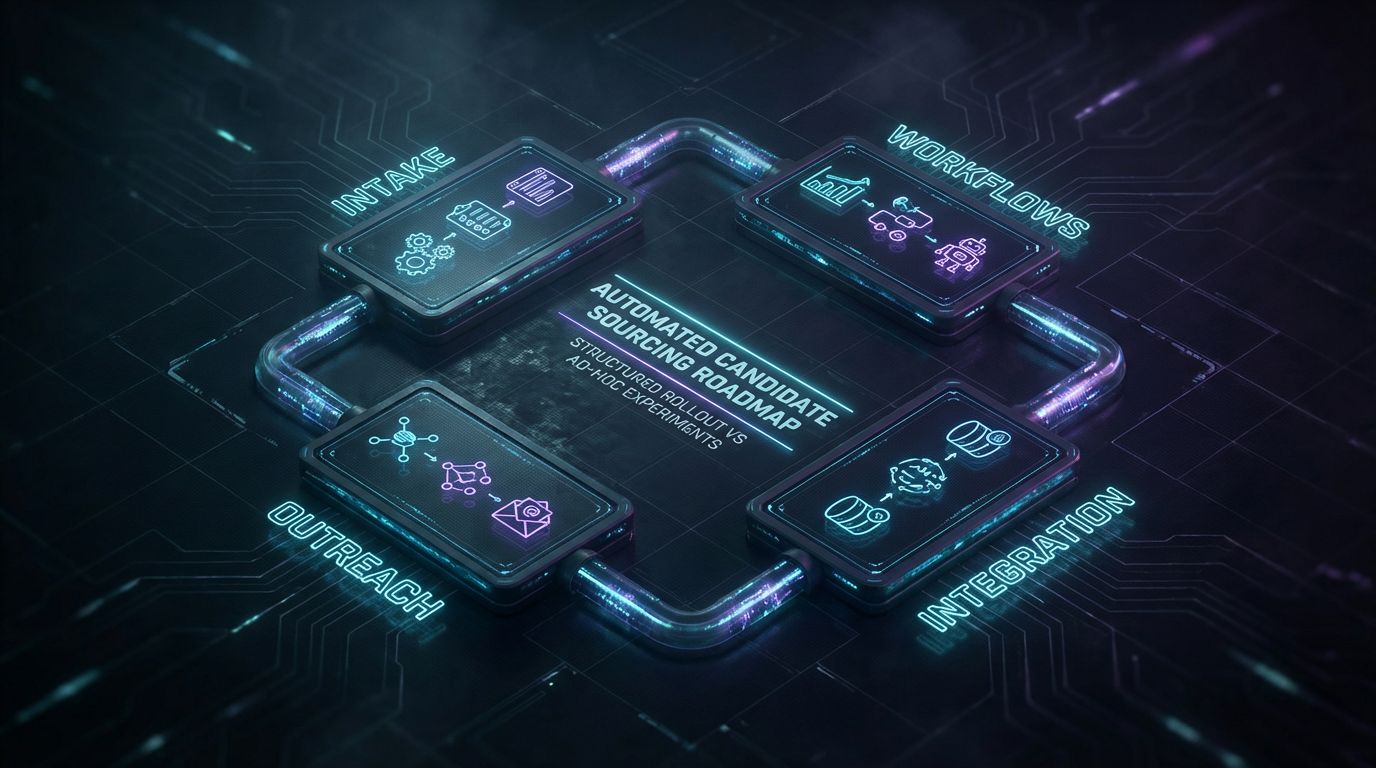
You do not need a 6-month transformation project to stand up a functioning automated recruiting stack. A focused 4–6 week implementation can cover core roles if you approach it as a workflow design problem, not a tool-shopping exercise. This is exactly how AiBizBuild structures a typical rollout.
Phase 1 – Intake, Personas, and Data Audit (Week 1)
We start by mapping the roles that matter most: volume hires, hard-to-fill hires, and critical recurring roles. For each, we define must-have criteria, nice-to-haves, and explicit diversity objectives so the system doesn’t just replicate historical bias. This becomes the backbone for search rules, enrichment logic, and screening bot questions.
In parallel, we audit your current data sources: ATS, CRM, past candidate lists, and how your team is using LinkedIn/Indeed today. The goal is to identify safe places where B2B Lead Scraping & Enrichment can plug in without violating terms of service or data privacy policies. We also map which fields in your ATS need to be trusted sources of truth.
Phase 2 – Scraping & Enrichment Workflows (Weeks 1–2)
Once roles and data sources are defined, we configure compliant scraping workflows that target specific talent pools. That might mean pulling from public profiles, conference attendee lists, alumni databases, or other allowed sources rather than blindly scraping entire platforms. We set explicit rate limits and schedules to keep activity platform-safe.
B2B Lead Scraping & Enrichment then normalizes titles, tags skills, verifies locations/time zones, and flags seniority levels. Where legally and ethically appropriate, we can also tag diversity-relevant proxies at the pool level for reporting, without making individual-level decisions. These enriched profiles become the input for Cold Outreach Automation.
Phase 3 – Outreach Sequences and Screening Bots (Weeks 2–3)
With enriched candidate pools in place, we design multi-channel outreach sequences that reflect your employer brand and hiring manager priorities. Cold Outreach Automation handles staggered campaigns across email and compliant LinkedIn-style messaging, with separate tracks for active vs passive candidates or different personas. Each sequence includes at least 3–5 touchpoints over 10–21 days.
HR & Recruitment Screening Bots intercept replies and provide structured next steps: basic fit questions, salary/location alignment, and documentation of must-have skills. For qualified candidates, bots can hand off directly to a 24/7 Appointment Booking System, allowing them to book time with a recruiter without back-and-forth emails. This combination routinely improves reply handling speed and protects your employer brand with consistent, on-message communication.
Phase 4 – ATS & CRM Integration, Routing, and Reporting (Weeks 3–4)
None of this matters if your ATS is still a mess. In this phase, we wire CRM Integration & Inbox Management so that enriched records, outreach status, and bot interactions flow into your ATS/HRIS in a structured, tagged format. That means a hiring manager can open a candidate record and see the full conversation history and qualification answers without digging through inboxes.
We also configure routing rules: which recruiter or hiring manager owns which role, how priorities are set, and how status updates in the ATS feed back into your sourcing and scoring logic. Finally, we stand up dashboards that track volume at each stage, response and qualification rates, time-to-screen, and cost per qualified candidate by role family.
What “Good” Looks Like: Cost per Qualified Candidate Benchmarks
Exact numbers vary by market and role, but you should have a realistic sense of what candidate sourcing automation can do. Below are illustrative benchmarks comparing manual vs automated approaches for typical roles. These aren’t guarantees; they are grounded, achievable ranges when automation is well-designed and governed.
| Scenario | Estimated Cost per Qualified Candidate | Primary Cost Drivers |
|---|---|---|
| Manual LinkedIn sourcing for Senior Engineer | $300–$400 per qualified candidate | 8–12 recruiter hours at $60–$80/hr fully loaded, LinkedIn licenses, low reuse of lists, higher agency backup spend. |
| Automated talent sourcing system for Senior Engineer | $120–$180 per qualified candidate | 3–5 recruiter hours focused on review and interviews, amortized automation build, ongoing tool costs, higher reuse of enriched pools. |
| Manual sourcing for high-volume SDR role | $150–$220 per qualified candidate | Significant recruiter time on repetitive searches, manual follow-up, and screening calls; job board posting fees. |
| Automated candidate sourcing for high-volume SDR role | $70–$120 per qualified candidate | Upfront configuration of scraping and screening bots, then low incremental recruiter time; outreach and scheduling largely automated. |
Even at the conservative end, a well-designed automated candidate sourcing system can reduce cost per qualified candidate by 20–40% while freeing 20–30 recruiter hours per month to focus on stakeholder management and closing.
If you want to see the same kind of implementation discipline applied to marketing, look at how we build AI SEO content systems that connect tools into end-to-end workflows, not just isolated apps. The same philosophy applies here.
Real-World Use Case: Automated Talent Sourcing for a Growth-Stage SaaS Company
To make this concrete, let’s walk through a realistic, anonymized scenario for a growth-stage SaaS company in the 200–500 employee range. This is the kind of environment where automated talent sourcing changes from “nice-to-have” to “survival strategy.”
Starting Point – Overworked TA Team and Stalled Hiring
The company has 6–10 open roles at any given time: Senior Engineers, Product Managers, and SDRs. The TA team has 2 recruiters who are spending 60%+ of their time on manual sourcing and chasing replies in their inboxes. ATS usage is inconsistent, so reporting on cost per hire or pipeline quality is almost impossible.
Most outreach happens through LinkedIn InMail and basic email templates, with occasional experiments in LinkedIn recruiter automation that made leadership nervous about compliance. Agencies are being used as a pressure valve, driving up cost per hire while internal recruiters burn out.
Designing the Automated Sourcing Stack
AiBizBuild starts with a Workflow Audit to map their current funnel and identify the highest-leverage roles. For Senior Engineers and Product Managers, we configure B2B Lead Scraping & Enrichment to build talent pools from public sources: competitor org charts, conference speakers, relevant GitHub and product communities where appropriate and permitted. Profiles are normalized, tagged by skill cluster, and segmented by geo/time zone.
Next, we design Cold Outreach Automation sequences segmented by persona (e.g., backend engineer vs product lead) and seniority. Messaging is tailored to their product, tech stack, and value proposition, and we A/B test subject lines and value hooks. HR & Recruitment Screening Bots then step in to handle first-touch replies: confirming interest, checking salary and location constraints, and capturing a brief experience summary.
For qualified candidates, bots push people directly to a 24/7 Appointment Booking System integrated with recruiters’ calendars, eliminating 3–5 back-and-forth emails per candidate. CRM Integration & Inbox Management pushes those records into the ATS with all context attached and tagged by source, persona, and campaign.
Outcomes: Time Saved and Cost per Candidate Improvements
Within the first full quarter after rollout, the TA team sees a 40–60% reduction in time spent on manual sourcing for the covered roles. Each recruiter can now support more active requisitions without sacrificing candidate experience. ATS data quality improves significantly because records are enriched and structured from day one.
Cost per qualified candidate for Senior Engineers drops from an estimated $350–$400 range to roughly $180–$220, primarily by reducing recruiter hours per candidate and lowering agency dependence. Interview-to-offer rates increase by 10–20% because the top of the funnel is more targeted and better qualified. This is what practical candidate sourcing automation looks like when it is treated as a system, not a side project.
Compliance Risks: LinkedIn, Indeed, and How to Stay Safe

You can build automated candidate sourcing that is powerful and platform-safe, but only if compliance is a first-class design constraint. Shortcutting this with cheap scrapers or aggressive LinkedIn recruiter automation scripts is how accounts get banned and legal teams get involved.
What Platforms Actually Forbid
While terms differ by platform and change over time, common red lines include: scraping at scale that mimics or exceeds human browsing speeds, using automated tools that pretend to be a human clicking and messaging, and repurposing data outside the scope users agreed to. Ignoring these rules exposes you to account bans and, in some regions, potential regulatory issues.
The practical takeaway: if your automation strategy relies on “don’t get caught” rather than “design within the rules,” you are building on sand. A temporary bump in volume is not worth losing critical sourcing channels.
Designing Platform-Safe Automation
A platform-safe automated talent sourcing approach uses a mix of official APIs, partner integrations, and compliant scraping of publicly available data. We enforce rate limiting, randomization, and clear separation between human actions (e.g., sending InMails from recruiters) and system actions (e.g., enriching records in your database). No “always-on” bots pretending to be humans inside LinkedIn.
CRM Integration & Inbox Management also centralizes opt-outs and preferences so that once a candidate declines, they are tagged and excluded from future outreach workflows. This doesn’t just reduce legal risk; it shows respect for candidates’ time and attention, which ultimately protects your brand.
Ethical & DEI Considerations in Automated Talent Sourcing
Automation can amplify bias if you let it simply replicate past hires. We explicitly design search and scoring rules to avoid using protected characteristics or obvious proxies as hard filters. Instead, we focus on skills, capabilities, and experience indicators aligned to role requirements, while using automation to broaden sourcing beyond “obvious” schools or employers.
HR & Recruitment Screening Bots are configured to avoid illegal questions and biased language, and to provide consistent information about roles, salary bands, and processes. In regions with stricter data and employment laws, we adjust workflows accordingly. You get the efficiency of candidate sourcing automation without compromising on ethics.
Tool Choices vs System Design: Why the Stack Matters More Than the Logo
At this point, most leaders ask, “Which AI sourcing tool should we buy?” That’s the wrong first question. Tools matter, but how you connect and govern them matters far more for sustainable results.
Popular AI Sourcing Tools Are Powerful—but Still DIY
Tools like Fetcher, hireEZ, and Team Engine can all be valuable components of your stack. But they are still DIY: they do not define your sourcing strategy, clean your historical data, or integrate themselves cleanly into your ATS. Out of the box, they are feature sets, not systems.
AiBizBuild’s focus is designing the system around them: what feeds in, what comes out, who owns each step, and how results get measured. The same way we build automated editorial workflows for content teams, we architect and orchestrate the end-to-end flow for recruiting.
The Hidden Costs of DIY Candidate Sourcing Automation
The apparent savings of DIY often disappear once you account for internal time spent on configuration and firefighting. Expect weeks lost to trial-and-error with integrations, broken webhooks, list hygiene problems, and misaligned scoring rules. Meanwhile, hiring managers keep asking why roles are still open and why the ATS data looks wrong.
There is also brand risk: a misconfigured outreach campaign can send the wrong message to thousands of candidates overnight. Buying a tool is not the same as having a candidate sourcing automation system. A done-for-you implementation is about reducing this hidden overhead and risk while giving you predictable metrics.
When to Bring in a Done-For-You Partner Like AiBizBuild
Not every organization needs outside help. But there is a clear point where the complexity of your funnel, toolset, and compliance requirements make a DIY approach more expensive than a structured implementation.
Signs You’ve Outgrown Manual Sourcing
- You have 5+ recurring roles per quarter that you are always hiring for (engineers, SDRs, CSMs, etc.).
- Your recruiters are spending 50%+ of their time on sourcing and inbox wrangling instead of interviews and stakeholder management.
- You rely heavily on agencies to backfill what your in-house team cannot source in time.
- Your leadership is asking for clear cost per qualified candidate and pipeline health metrics you cannot reliably produce.
What AiBizBuild Actually Delivers
AiBizBuild does not sell a single “AI sourcing” tool. We design and implement the system using a focused set of capabilities:
- B2B Lead Scraping & Enrichment blueprints and automations tailored to your core roles and markets, with compliance guardrails baked in.
- Cold Outreach Automation sequences, personalization logic, and testing plans mapped to your employer brand and talent personas.
- HR & Recruitment Screening Bots configured with your intake questions, integrated into your ATS, and tuned to your definition of “qualified.”
- CRM Integration & Inbox Management that turns a mess of email threads and spreadsheets into a single, trustworthy recruiting data layer.
- Optional AI Voice Agents and 24/7 Appointment Booking Systems to further reduce friction in scheduling and candidate Q&A.
The implementation model is similar to our workflow automation implementation blueprint work in other domains: clear phases, owners, and acceptance criteria, typically delivered over 4–6 weeks.
What a Workflow Audit Looks Like (and Next Steps)
The entry point is a Workflow Audit, not a sales demo of random features. Over a 60–90 minute intake, we map your current funnel from intake to offer, including tools, data flows, and failure points. We then quantify where you are burning recruiter hours and how that translates into cost per qualified candidate.
Within 1–2 weeks, you receive a practical blueprint: prioritized roles, recommended workflows, required integrations, and a staged 4–6 week rollout plan. From there, you can choose to implement internally or engage AiBizBuild for a done-for-you buildout. If you want to see the system in action, you can also request a demo of our HR & Recruitment Screening Bots and outreach automations.
CTA: If you suspect your team is stuck in manual mode or fragmented DIY setups, book a Workflow Audit with AiBizBuild to see what a fully integrated automated candidate sourcing system would look like for your org.
FAQs About Automated Candidate Sourcing
How long does it take to implement an automated candidate sourcing system?
For most organizations, a core system for 3–5 key roles can be implemented in 3–6 weeks. Weeks 1–2 cover intake, role mapping, and data audits; weeks 2–3 handle scraping, enrichment, and initial outreach workflows; weeks 3–4 focus on ATS/CRM integration and dashboards. Additional roles or regions can be layered on in subsequent 2–3 week mini-phases.
Do we need to change our ATS to use candidate sourcing automation?
In most cases, no. The heavy lifting happens in CRM Integration & Inbox Management, which sits around your existing ATS/HRIS and connects it to scraping, enrichment, outreach, and bots. As long as your ATS has basic integration points (APIs, webhooks, or import/export), we can usually make it work without a rip-and-replace project.
Is automated talent sourcing compliant with LinkedIn and Indeed policies?
It can be, if it is designed with those policies in mind. That means avoiding aggressive scraping or fake human behavior, using official integrations where available, and respecting data usage limits. AiBizBuild explicitly designs automated talent sourcing workflows to be platform-safe and to centralize opt-outs and consent.
Will automated outreach and screening bots hurt our candidate experience?
Poorly designed bots absolutely can, but well-designed ones usually improve candidate experience. Cold Outreach Automation ensures timely and relevant follow-up, while HR & Recruitment Screening Bots provide fast responses, clear next steps, and consistent information. We always keep humans in the loop for edge cases and ensure candidates can easily reach a real person.
What internal resources do we need to make this successful?
You will need a TA lead who can make process decisions, hiring managers to participate in role intake, and light IT support for integration approvals and access. AiBizBuild handles the heavy lifting on workflow design, configuration, and optimization so your team is not stuck learning a new automation platform from scratch.
Do we need engineering or coding skills to maintain the system?
No, day-to-day use is typically configuration-level: adjusting messaging, adding roles, and tweaking routing rules through interfaces. The more technical work—building and maintaining the underlying integrations, enrichment logic, and monitoring—is part of AiBizBuild’s ongoing support if you choose a done-for-you model.
Conclusion: Automated Candidate Sourcing as a Competitive Advantage
Manual sourcing will always have a place for truly niche or executive roles, but it cannot be the backbone of a modern hiring engine. A well-designed automated candidate sourcing system turns fragmented tools into a coherent pipeline from intake to ATS, with measurable improvements in time-to-fill and cost per qualified candidate.
Instead of burning recruiter hours on copy/paste and inbox triage, you reallocate that time to candidate conversations, stakeholder alignment, and closing. Compliance and data hygiene move from “we hope” to “we know,” because workflows are explicit and monitored rather than improvised.
If you are ready to move beyond LinkedIn tab overload and DIY experiments, now is the time to book a Workflow Audit or request a demo of AiBizBuild’s HR & Recruitment Screening Bots and sourcing automations. We will show you exactly what a tailored, end-to-end candidate sourcing automation system could look like for your team over the next 4–6 weeks.