

AI for Real Estate Leads: Automating Listings, Ads & Social for Agents
Key Takeaways
– Agents relying on manual lead gen spend 10–20 hours/week on inconsistent, one-off tasks, while an AI for real estate leads system centralizes listings, ads, and follow-up into a predictable engine.
– When you combine automated real estate social media posts, AI listing promotion, and AI lead scoring, most agents can reclaim 10–15 hours/week and respond to new leads 5x faster.
– Tools alone rarely deliver; consistent ROI comes from a done-for-you AI workflow build that connects social, listings, and follow-up into one lead engine your team actually uses.
In This Guide:
– The New Landscape: AI for Real Estate Leads
– Manual Marketing vs AI-Driven Lead Engines
– Why DIY Real Estate AI Stacks Fail
– Playbook #1: Automated Listing Promotion & Ads
– Playbook #2: Real Estate Social Media Automation
– Playbook #3: AI Lead Scoring & Follow-Up
– Time & Cost Comparison: DIY Tools vs Done-For-You Automation
– Implementation with AiBizBuild
– FAQs
The New Landscape: AI for Real Estate Leads
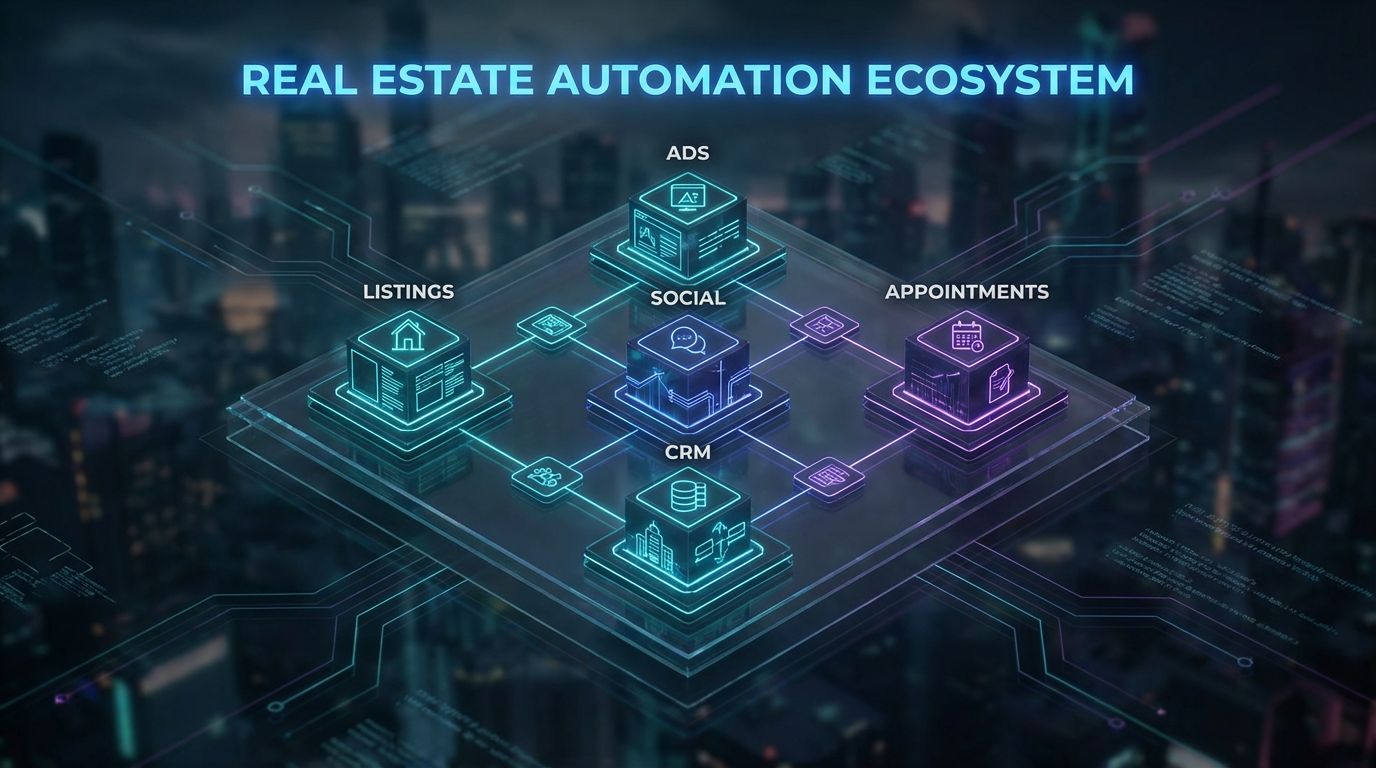
In practical terms, AI for real estate leads means using automation to do the repetitive work around your listings, ads, social content, and follow-up so you can spend more time in appointments. It is less about shiny tools and more about creating a system that promotes properties, captures interest, and nurtures buyers and sellers automatically. When designed well, an AI lead engine for real estate runs quietly in the background and surfaces only the conversations that need your expertise.
Top agents and small teams are already using AI to auto-promote listings across multiple channels from a single trigger. They run always-on lead capture and nurturing so that every new inquiry gets a response within seconds, not hours or days. Their social feeds stay active with automatic real estate social media posts that mix listings, education, testimonials, and local content without anyone logging in every day.
The tools to do this are widely available, but the results depend entirely on workflow design and integration. If your CRM, ad accounts, scheduling tools, and inboxes are not talking to each other, you end up with more noise, not more deals. That’s where a done-for-you approach becomes the difference between “playing with AI” and having an AI-powered real estate lead generation engine.
Channels Where AI Can Plug Into Your Existing Lead Flow
IDX/Website: AI can watch for new form fills, chat conversations, or property views and instantly send tailored follow-up messages, qualify the lead, and log everything to your CRM.
Zillow/Realtor.com: When a portal lead comes in, AI can trigger an automated text or AI Voice Agent call within seconds, ask a few qualifying questions, and propose appointment times.
Google/Facebook Ads: Instead of sending ad leads into a black box, AI can auto-enroll them into nurture sequences based on campaign, property type, or intent tags. It then adjusts messaging over time based on engagement.
Instagram/TikTok/YouTube: Social posts and short-form video scripts can be generated by AI from your listings and local data, then scheduled to publish consistently without manual intervention.
Email: AI can draft and send segmented email drips for new buyers, sellers, past clients, and sphere, all triggered by behaviors like link clicks, page visits, or replies.
Phone: AI Voice Agents can handle after-hours calls, missed calls, and outbound callbacks, ensuring a human-like experience while your team is in showings. Hand-offs to you happen only when the conversation is qualified and ready.
Manual Marketing vs AI-Driven Lead Engines

What Manual Lead Gen Looks Like for the Average Agent
For most agents, marketing still looks like logging into multiple platforms and doing everything by hand. You write social captions one by one, resize listing photos, post to Facebook and Instagram separately, and maybe hit “boost” on a couple of posts. Then you copy new leads into your CRM, chase cold leads with ad-hoc texts, and write follow-up emails from scratch.
Across a week, that adds up fast. It’s common to see 10–20 hours/week spent on non-revenue-generating busywork that could be automated. The real cost is not only the hours but the opportunities lost when follow-up is delayed and your content goes dark during your busiest weeks.
What an AI-Driven Lead Engine Looks Like
An AI-driven lead engine replaces those one-off tasks with connected workflows. New listings are syndicated automatically into platform-specific posts, stories, and email snippets, and ads are prepared with minimal tweaks. Your real estate social media automation runs on a schedule, so listings, market insights, and testimonials go out even when you’re in back-to-back showings.
Every new lead—whether from your website, portals, or ads—lands directly in your CRM with tags, notes, and a tailored follow-up path. AI handles the first touch, qualification questions, and reminders, while you focus on appointments, pricing strategy, and negotiations. Instead of juggling eight tools, you see a simple pipeline and calendar filled with qualified conversations.
Manual Marketing vs AI Engine: Time, Consistency, and Cost
| Aspect | Manual Marketing | AI-Driven Lead Engine |
|---|---|---|
| Time per Week | 10–20 hours creating posts, copying data, writing one-off emails | 3–5 hours reviewing performance and handling high-value conversations |
| Consistency of Lead Flow | Spikes when you have time, drops when you get busy | Steady cadence of content, ads, and follow-up regardless of your schedule |
| Response Speed to New Leads | Minutes to hours, often next day for off-hours inquiries | Seconds, with automated SMS/email and AI Voice Agent callbacks |
| Cost (Your Time @ $100–$200/hr) | $1,000–$4,000/week in opportunity cost doing admin work | A fraction of that in automation plus more time for revenue-producing activities |
Why DIY Real Estate AI Stacks Fail
The Tool Trap — Lots of Subscriptions, No System
Most agents discover AI through individual tools: an AI copy generator, a social scheduler, a chatbot, a CRM add-on. They sign up for trials, add a few subscriptions, and end up with a dozen logins and no single flow from lead capture to appointment. The result is scattered experiments instead of a working AI lead engine.
DIY Reddit-style stacks—scrapers, Sales Navigator, multiple cold email senders—look powerful on paper but are often overkill and fragile for a local real estate business. When nothing is orchestrating these tools, you get duplicate messages, dropped leads, and inconsistent branding. The “tool trap” is paying for more software while still relying on manual effort to hold it together.
Hidden Costs: Setup, Integration, and Ongoing Maintenance
What most listicles never mention is the invisible work between tools. Someone has to write prompts, map fields into your CRM, design nurture sequences, set up tags and triggers, and configure unsubscribe and compliance logic. Even tech-savvy agents underestimate how much time disappears into settings screens and testing.
Once it’s live, things still break—API changes, credential issues, platform rule updates, or a field name changing in your CRM. Without someone owning maintenance, you can go weeks before noticing that new leads aren’t getting follow-up. Those hidden costs are why many agents quietly abandon their DIY real estate social media automation and fall back to manual posting.
When DIY is a Good Idea (and When It Isn’t)
There are times when DIY makes sense. If you’re experimenting with one channel—say, a simple newsletter or a personal TikTok series—trying a standalone tool is a low-risk way to learn. You can keep it light and accept that it’s not fully integrated.
But your core pipelines for listings, buyer leads, and seller inquiries are too valuable to hang on a fragile tool stack. For those, a done-for-you build protects your time, your brand, and your ability to scale. You stay in control of strategy while a specialist team designs and maintains the workflows that keep your lead engine running.
Playbook #1: Automated Listing Promotion & Ads
The Manual Way: Copy-Paste Listings Everywhere
Manually promoting a listing usually means copying your MLS description into Facebook, tweaking it for Instagram, uploading photos, and rewriting the caption again for email. Maybe you log into your ad manager and boost a post or set up a basic ad if you have time. Each channel feels like starting from scratch, and it’s easy to forget one altogether.
As your listing volume grows, this becomes unsustainable. A busy week of showings can mean listings that never get proper social promotion or targeted ads. The inconsistency shows up directly in your inquiries and open house traffic.
The AI-Driven Workflow for Listings
With an AI-driven listing workflow, you design the process once and let it run for every new property. Here’s how it can look when powered by AiBizBuild’s services.
- New listing hits MLS/CRM. As soon as you add a listing to your MLS or CRM, CRM Integration & Inbox Management detects it and pulls key data: price, beds/baths, address (or area), highlights, and photos.
- Automation trigger fires. That new listing record triggers a workflow that prepares content for multiple channels at once. You don’t log into individual platforms to kick this off.
- Social Media Workflow Automation creates posts. The system generates a set of listing posts: a short teaser caption for Instagram, a more detailed Facebook/LinkedIn post, a story script, and a snippet for your email list. Each is formatted to match the platform’s style.
- Ads-ready copy and creatives are produced. AI drafts ad headlines, descriptions, and suggested audiences for Facebook/Instagram and Google. You or your team only need to approve and set budgets.
- 24/7 Appointment Booking link is embedded. Every asset—from posts to emails to ads—includes a link to your 24/7 Appointment Booking System, so interested buyers can book showings or consults without back-and-forth.
Here are two example AI-generated snippets you might see in this workflow:
- Instagram teaser: “New in North Hills: 4-bed modern farmhouse with a resort-style backyard. Quiet cul-de-sac, minutes from top-rated schools. Want the full tour? Tap to schedule a private showing this weekend.”
- Email snippet: “Just listed: a move-in-ready 3BR in Oak Creek under $500K. Open floor plan, updated kitchen, and a backyard built for summer. Click here to grab one of the first showing slots before it hits every portal.”
These are generated from your listing data and brand voice rules, then pushed into your channels without you rewriting the same description five times. You step in only to review and approve.
Time & Cost Impact for a Single Listing
Manually promoting one listing across social, email, and ads can easily take 1.5–3 hours when you include writing, image prep, posting, and basic ad setup. An AI-driven workflow compresses that into a short review and approval cycle, often under 30 minutes. That’s a savings of roughly 1–2.5 hours per listing.
If you handle four new listings per month, you’re looking at 4–10 hours/month reclaimed just from listing promotion. For larger teams with higher volume, that number multiplies quickly and frees up entire days for prospecting, showings, or negotiating offers.
Playbook #2: Real Estate Social Media Automation

From Sporadic Posts to Automatic Real Estate Social Media Posts
Most agents post on social when something happens—a new listing, a closing, or a price reduction. During busy weeks, social goes quiet, and your brand disappears from the feeds of people who are casually thinking about buying or selling. That inconsistency makes it hard to build authority or stay top of mind.
With a system for automated real estate social media posts, your presence no longer depends on your energy level or calendar. The engine publishes a balanced mix of listings, local tips, testimonials, and market stats on a set schedule. You can still add personal, in-the-moment content, but the baseline visibility is handled for you.
Building a Real Estate Social Media Automation Engine
AiBizBuild’s Social Media Workflow Automation is built specifically to remove the daily grind of content creation while keeping your brand consistent. At the start of each month, AI generates content themes based on your target neighborhoods, price points, and audience segments. It then uses those themes to create post variations tailored for Instagram, Facebook, LinkedIn, and even TikTok or short-form video scripts.
We often pair this with AI post maker tools for automated social content behind the scenes, but the key is the workflow, not the logo on the tool. A scheduler handles automatic publishing, so you get automatic real estate social media posts going out whether you’re at your desk or on a listing appointment. Most agents who try to DIY this with generic schedulers discover how easy it is to misconfigure; that’s why we also lean on best practices from our guide on social media scheduling tools and automated publishing workflows.
Example Weekly Content Calendar (Automated)
A simple, automated weekly calendar might look like this:
- Monday: Just-listed carousel post highlighting a new property with 5–7 photos and a short caption.
- Tuesday: Educational market insight (e.g., “What rising rates mean for move-up buyers in [Your City]”).
- Wednesday: Client testimonial quote card with a short story about the transaction.
- Thursday: Short-form video or reel script about a local neighborhood spotlight.
- Friday: Open house or weekend showing promo with a direct link to your 24/7 Appointment Booking System.
In a well-designed system, 70–80% of this calendar is generated and scheduled automatically. You might personalize certain posts with your own story or add ad-hoc content when something noteworthy happens. For a deeper dive into planning, we often reference our approach to automated social media content calendars, then adapt those workflows to real estate specifics.
Playbook #3: AI Lead Scoring & Follow-Up
The Problem: Wasting Time on Unqualified Leads
Every agent knows the frustration of chasing leads who just wanted a Zestimate or clicked on an ad out of curiosity. You call once or twice, leave a voicemail, maybe send one follow-up text, and then move on. Meanwhile, genuinely motivated buyers and sellers sometimes slip through because they didn’t get a fast enough response.
Without any lead scoring or structured nurture, your time naturally gets pulled toward whoever happens to pick up the phone. That’s not the same as focusing on the people most likely to transact in the next 30–90 days. AI can quietly change that dynamic.
AI-Enhanced Lead Capture, Scoring, and Nurture
An AI-enhanced follow-up flow starts at the moment a lead appears, not when you next check your inbox. Here’s how an integrated workflow can look.
- Lead captured from website, ad, or portal. CRM Integration & Inbox Management logs the new contact, source, and key details (property viewed, form submitted, or ad clicked).
- Initial outreach fires automatically. Within seconds, an SMS or email goes out acknowledging the inquiry and asking one or two light qualifying questions.
- AI Voice Agents engage where appropriate. For higher-value or high-intent sources, an AI Voice Agent (Inbound/Outbound) can call to ask a short series of questions and capture answers directly into your CRM.
- Lead scoring logic runs in the background. Simple criteria—timeline (0–3 months vs 6+), budget range, loan pre-approval status, and whether they have an agent—are used to assign a score.
- Next steps are tailored by score. High-score leads are invited to pick a slot via your 24/7 Appointment Booking System, while medium-score leads enter a nurture sequence managed by Cold Outreach Automation.
Here are two example qualifying message sets:
- Buyer SMS sequence: “Thanks for requesting info on homes in [Area]. Quick question: Are you looking to move in the next 3 months, 3–6 months, or ‘just browsing’ for now? Also, are you already pre-approved or still exploring options?”
- Seller email sequence: “I saw you requested a home value estimate for your property in [Neighborhood]. Are you considering selling in the next 6–12 months, just curious about current value, or comparing options before deciding? If you’d like, I can send a quick 3-step plan to maximize your sale price in this market.”
These questions are straightforward for the lead to answer but powerful for you. They let the system separate warm opportunities from long-term nurture and ensure nobody falls through the cracks while you’re in the field.
Quantifying the Impact on Conversion Rates
When follow-up is immediate and structured instead of ad-hoc, you see measurable improvements. It’s common to achieve 5x faster response times simply by letting AI handle the first touch. Faster response alone is strongly correlated with higher appointment rates, especially for ad and portal leads.
Well-designed workflows often produce 20–40% more live conversations from the same lead volume because fewer inquiries go unanswered. On the time side, agents routinely save 10+ hours/week they previously spent on manual dialing, chasing unresponsive leads, and writing one-off follow-up messages. These are not guarantees, but they are realistic patterns when AI for real estate leads is implemented as a connected system rather than a collection of tools.
Time & Cost Comparison: DIY Tools vs Done-For-You Automation
The Real Cost of Stitching Tools Together Yourself
A typical DIY stack for AI-powered real estate lead generation might include: an AI copy tool, a design tool, a social scheduler, a separate email platform, a landing page builder, a CRM, and maybe a chatbot or call tracking system. Each comes with its own subscription fee and learning curve. On paper the monthly software cost might look manageable, but the real cost is the time it takes to wire everything together.
It’s not unusual for an agent or team leader to spend 20–40 hours just on initial setup—connecting APIs, configuring webhooks, setting tags, and testing edge cases. After that comes ongoing troubleshooting when one part changes or breaks. Support is fragmented, which means each vendor can only help with their own box, not the entire flow that generates your leads.
DIY Stack vs AiBizBuild Implementation
| Aspect | DIY Tool Stack | AiBizBuild Done-For-You |
|---|---|---|
| Setup Time | 20–40+ hours of self-setup, trial-and-error, and debugging | 2–4 week implementation handled by automation specialists |
| Monthly Tool Costs | Multiple overlapping subscriptions, often underutilized | Streamlined stack; only tools that directly support the workflows we design |
| Reliability | Fragile connections, higher risk of silent failures and missed leads | Architected workflows, monitored and adjusted over time |
| Support | Each vendor supports only their piece; you own the integration | Single partner responsible for the end-to-end lead engine |
| Results | Inconsistent; depends on your spare time and tech skills | Designed for predictable, trackable improvement in response times and appointments |
Why Hiring an Agency is Often Cheaper Than DIY
When you value your time at $100–$200/hour, spending dozens of hours assembling and maintaining a DIY stack quickly eclipses the cost of a specialist team. One additional closed transaction per year often covers months of done-for-you automation, especially at higher price points. More importantly, you’re not betting your lead flow on nights and weekends when you have the energy to tinker with settings.
With AiBizBuild, you get a partner that designs, implements, and maintains the workflows that matter most: listings, social, and follow-up. You still own the strategy and brand voice, but you no longer have to be the de facto marketing ops and automation architect for your own business. That shift is what makes ai for real estate leads sustainable instead of just another experiment.
Implementation with AiBizBuild
—IMAGE_BLOCK: Futuristic Glass & Metal Product Shot of a sleek modular console labeled with icons for Social Automation, Voice Agent, CRM, and Calendar, arranged as a single premium system on a dark desk. Cinematic lighting, Unreal Engine 5 render, futuristic corporate aesthetic, glowing cyan and purple accents, shallow depth of field, 8k resolution—
What We Actually Do for Real Estate Lead Engines
AiBizBuild is not another SaaS login. We are a premium, done-for-you automation agency that builds and maintains your real estate lead engine using a focused menu of services.
- Social Media Workflow Automation: We design and implement real estate social media automation so your brand publishes consistent, on-brand content and listing promos without daily effort.
- Cold Outreach Automation: We build email and SMS sequences that re-engage old leads, nurture long-term buyers and sellers, and follow up automatically when a new inquiry comes in.
- AI Voice Agents (Inbound/Outbound): We configure AI callers to handle initial qualification, callbacks on missed calls, and follow-ups, with clear hand-offs to your team.
- 24/7 Appointment Booking Systems: We implement calendar flows that turn interest into booked showings or consults at any hour, integrated directly with your CRM.
- CRM Integration & Inbox Management: We connect your lead sources, inboxes, and CRM so every interaction feeds your lead scoring and follow-up logic.
- Optional SEO Content & Blog Automation: Where it makes sense, we build automated content workflows that support your inbound lead magnets and neighborhood authority.
All of this is tailored to your market, price point, and brand tone. You get a cohesive system rather than a pile of disconnected tools.
A Typical 30-Day Build Timeline
Most real estate implementations follow a structured 30-day plan. The exact timing depends on your current stack and access, but the phases are consistent.
- Week 1 – Audit & Strategy: We map your current lead sources, CRM, and follow-up habits, then define goals for listings, social, and appointments.
- Week 2 – Workflow Design: We architect the end-to-end workflows for listing promotion, automated real estate social media posts, and AI-driven follow-up and lead scoring.
- Week 3 – Implementation & Content Setup: We connect tools, configure automations, and build baseline content templates and voice guidelines.
- Week 4 – Testing, Go-Live & Training: We run test leads, fix edge cases, go live, and train your team on how to work with the new system day-to-day.
By the end of the first month, you have a functioning AI lead engine, not a theoretical roadmap. From there, we iterate based on real data and feedback from your agents.
How to Engage: Book a Workflow Audit
The best next step is simple: Book a Workflow Audit with our team. In 30 minutes, we review your current marketing and lead workflows, identify gaps, and outline what an AI-powered real estate lead engine could look like for your business.
You’ll walk away with a high-level workflow map, a gap analysis across listings, social, and follow-up, and a recommended rollout plan if we decide to work together. Whether you’re a solo agent, team leader, or small broker-owner, the audit is designed to show you exactly where automation can return the most hours and the fastest lift in appointments.
If you’re tired of juggling tools and still not seeing predictable lead flow, this is where you shift from scattered experiments to a system built around your business. Book a Workflow Audit and let AiBizBuild handle the architecture and implementation so you can get back to selling.
FAQs
How long does it take to set up an AI lead engine for my real estate business?
Most implementations are completed in about 3–4 weeks. The first week is focused on auditing your current stack and gathering access to your CRM, website, ad accounts, and social profiles. The remaining weeks cover workflow design, implementation, testing, and agent training, with go-live typically at the end of week four.
Do I need to switch CRMs to use AI for real estate leads?
In most cases, no. Our CRM Integration & Inbox Management approach is designed to work with your existing CRM wherever possible, connecting it to your lead sources, appointment booking, and automation workflows. We only recommend switching CRMs if your current system fundamentally cannot support the workflows you need or lacks critical integration capabilities.
Is AI-driven lead follow-up compliant and safe for my brand?
Yes, when it’s designed correctly. We build workflows with clear opt-out mechanisms, respect for local and TCPA-style regulations where applicable, and brand-approved templates for all outgoing messages. Sensitive or high-stakes communications can be routed for human review so that AI amplifies your brand standards instead of risking them.
What if my team isn’t tech-savvy? Will they actually use the system?
The goal is for your agents to work with simple dashboards, notifications, and calendars—not complex automation tools. We handle the configuration and maintenance behind the scenes, so your team mainly sees qualified leads, reminders, and booked appointments. Training focuses on how to respond and update statuses, not how to build workflows.
How do you measure ROI on AI for real estate leads?
We track both productivity and performance metrics. On the productivity side, we look at hours saved per week on tasks like posting, data entry, and manual follow-up. On the performance side, we monitor response time, appointment rate per lead, cost per appointment for paid campaigns, and pipeline value generated; together, these metrics show whether your AI lead engine is turning time saved into more conversations and closed deals.
What kind of marketing budget do I need for this to make sense?
AiBizBuild works best for agents, teams, and small brokerages who are already investing time or money into lead generation—whether that’s paid ads, portal leads, or heavy organic efforts. If you’re closing a handful of transactions per year, the leverage from automation may be limited, but once you’re at a steady volume, one or two additional deals can more than cover the investment in a done-for-you AI lead engine.
Ready to see what this would look like for your specific market and team? Book a Workflow Audit and we’ll map it out with you.